Showing posts with label rabbis. Show all posts

1/24/26

Talmudic Chaos v. Halakhic Linearity in the Logic of Judaism

In 2011 I published an article, "In Search Of The Logic Of Judaism: From Talmudic Chaos To Halakhic Linearity," which you can download and read from the link here.   


I used mathematical ideas to differentiate the linear organization of the halakhah from non-linear thinking of the Talmud. Our abstract says: 

In this paper I examine some common views of scholars concerning the idea of the halakhah in Judaism. I then explain why their methods failed to account for the main philological and historical evidence regarding the term from the Talmudic texts. Then I suggest as a heuristic explanation that the logic of the Talmud defies linearity and can be discussed productively using chaos theory.

The authors in this volume cover varied topics with sophistication and erudition. The publisher's page provides details about the book, as copied below. 

11/14/25

Thanksgiving Sermon of Rabbi Zev Zahavy from 1943

Here is my dad's incredible inspiring and uplifting sermon from 1943 for the holiday of Thanksgiving. It was a dark year in the history of humankind. Yet Rabbi Zahavy found ways to weave together precepts from our classical Jewish tradition to give hope and optimism to those who faced the bewildering frightening world of 1943.

I read this sermon every year and it inspires me more each time. My father was an impresario of the rabbinic pulpit.

Click here for the original text of Rabbi Zev Zahavy's 1943 Thanksgiving Sermon, published by the RCA, Rabbinical Council of America.

From the Manual of Holiday and Occasional Sermons, published in 1943 by the Rabbinical Council of America. This publication contains various sermons for Jewish holidays like Rosh Hashanah, Yom Kippur, and Succoth, as well as other occasions. Specifically, the excerpts detail the full text of a sermon titled “Reasons for Thanksgiving Today” by Rabbi Zev Goldstein, which discusses why American Jews should observe the Thanksgiving holiday, even amid the second World War. The sermon explores themes of gratitude, faith, and hope during a period of global crisis, referencing the importance of thanking G-d for safety, recovery from illness, and freedom from servitude.

Here is a link to the video overview from NotebookLM (2025 - my dad would've liked this).  
And here is the link to the notebook itself. Or click below and watch. Expand it to full screen for greatest enjoyment!


A big hat tip to Zechariah for finding this and sending it to us.
This sermon for Thanksgiving Day discusses the following main points:
* **The Importance of Thanksgiving:** The sermon emphasizes the significance of Thanksgiving as a time for reflection and gratitude, especially during challenging times.
* **Reasons for Thanksgiving:** It explores the four reasons for giving thanks mentioned in the Talmud: safe passage across the ocean, completing a journey through the wilderness, recovery from illness, and release from servitude.
* **Challenges to Gratitude:** The sermon acknowledges the difficulties in finding reasons for gratitude in the face of war, suffering, and injustice.
* **The Jewish Perspective on Suffering:** It highlights the Jewish tradition of finding meaning and expressing gratitude even in difficult circumstances, drawing on the example of Rabbi Akiva.
* **Hope and Faith in the Future:** The sermon emphasizes the importance of maintaining hope and faith in the future, even during times of crisis.
* **A Prayer for a Better Future:** It concludes with a prayer for a future characterized by peace, justice, and freedom.
Overall, the sermon encourages listeners to find reasons for gratitude and to maintain hope for a better future, even in the face of adversity.

9/26/25

A Happy St. Patrick's Day Recollection: When a Little Boy Met the Jewish Lord Mayor of Dublin Ireland


One St. Patrick's day, when I was a little boy, I met Bobby Briscoe, the Jewish Lord Mayor of Dublin Ireland, at my father's synagogue in New York City on East 67th Street.


I vividly remember his top hat and the big medal around his neck which swung out at me when he bent down to shake my hand. 

It was a grand day for the Jewish and the Irish!

The New York Times wrote up the visit. A wonderful New York story of a previous innocent age. 

New York Times. Published: March 17, 1957

BRISCOE ATTENDS PRE-PURIM RITES 
Lord Mayor Prays at Altar in Traditional Shawl - Pays Visit to Cardinal
By IRVING SPIEGEL ·

The Lord Mayor of Dublin devoted forty minutes yesterday morning to being plain Robert Briscoe and worshiping in the Orthodox Jewish faith of his ancestors.

He prayed at a Sabbath of Remembrance and pre-Purim service at Congregation Zichron Ephraim, 163 East Sixty-seventh Street. With the prayer shawl he brought with him for the service around his shoulders, he received the Orthodox honor, aliyah - an invitation to the altar.

Then he recited the traditional prayers in Hebrew before and after readings from the Torah. The aliyah was also extended to City Council President Abe Stark and Kings County District Attorney Edward S. Silver, who had of accompanied Mr. Briscoe to the synagogue.

Because of a heavy schedule, Mr. Briscoe and his group did not stay for the entire service. Rabbi Zev Zahavy, spiritual leader of the congregation said that the Lord Mayor's presence at the services was "an inspiration to all Jews in America and throughout the world."

In keeping with the Orthodox custom of not riding on Saturday, the Lord Mayor and his group walked from the Pierre Hotel, where he is staying, to the synagogue. In addition to Mr. Silver and Mr. Stark, Mr. Briscoe was escorted by two detectives of Jewish and Irish extraction, Ely Kerner and John O'Hagan.

Wears Kelly Green Tie

The Lord Mayor wore a cut-away coat, a black topper, a Kelly green tie with a golden harp embroidered in it.

As he strode up Fifth Avenue to attend synagogue services. he passed a group of policemen awaiting their parade assignments and remarked: "Top o' the morning. It's a fine day."

He paused to talk to a group of policewomen. Holding his prayer shawl, he told one young policewoman that, if she saw her commanding officer, "tell him I'm on my way to say my prayers."

Leaving the synagogue, he stopped at Engine Company 39, at 157 East Sixty-seventh Street, and told Lieut Joseph Kennedy, the commander: "No fires today, it's St. Patrick's Day."

Earlier in the morning, he had visited Cardinal Spellman at the Roman Catholic prelate's reidence at 452 Madison Avenue. Mr. Briscoe delivered a personal greeting in behalf of Archbishop John Charles McQuade of Dublin, and gave the Cardinal forty-five sets of Rosary beads, three boxes of chocolates and a glass bowl - all products of Ireland.

Cardinal Spellman told his guest: "There has not been as much excitement here since the Dionne quintuplets." Mr. Briscoe remarked that he was going to attend synagogue services.

"Be sure to leave all those Rosary beads here," the Cardinal replied with a laugh.

Mr. Briscoe laughed. "That's very good, very good," he said.

He returned to the Pierre, but not before being hailed by storekeepers, taxicab drivers and pedestrians. There was a brief rest and then he set out for the synagogue. Mr. Briscoe had originally intended to attend services at Congregation Rodeph Sholom on West Eighty-third Street but decided against it because of the long walk.

He returned to the hotel at noon for a brief visit with James A. Farley, chairman of the parade, and out again - this time for the St. Patrick's Day Parade with a ringing declaration of: "What a beautiful day!"

And fast forward to 2025 - my son and two grandsons are lifting a pint to celebrate the family ties in Dublin - visiting to cheer on the Minnesota Vikings football team!


10/8/22

Atlantic: Can You Read on an Amazon Kindle on Shabbat?

I originally posted this 12/23/2010. 
The questions keep recurring so we are bringing this post back. And by the way, I published a lot of books on Kindle since then, 
Now back to the 2010 blog post...

Our Jewish calendars have always told us what time to Kindle for the Sabbath, when to "Kindle the Shabbat Candles."

Nowadays we have another kind of Kindle to know about, the Amazon book reader. And the question arises, can you Kindle on the Sabbath?

We think yes, without any qualifications, that you can Kindle on the Sabbath. The e-ink device does not create actual light. You cannot read it in the dark. And it obviously does not create any durable writing. When you turn it off it goes blank.

In halakhic terms we find no transgression, no prohibition to using the reader. In fact it's a feat of great imagination to extend Sabbath prohibitions to that invention. It involves believing there is a set of electrical apparatus that is prohibited, or defining a broad category of technology-things that all are outside the spirit of Sabbath rest.

9/17/22

Does the Talmud say that Gay Sex Causes Earthquakes?


I'm quoted  in the Pacific Standard as an authority on the cause of earthquakes, "Gay Sex Caused the Earthquakes in Nepal."

On 8/23/2011 I wrote this post:

Does the Talmud say that Gay Sex Causes Earthquakes? In 2010 I covered this nonsensical topic after the Haiti earthquakes. (At that time Jeffrey Goldberg of the Atlantic cited me on this subject.)

Here it is again.

Yes, the Talmud does say that gay sex causes earthquakes.

I mused, That must be some awesome gay sex.

But seriously, if one can get serious over this bizarre idea, some cockamamie rabbis were going around preaching that gay sex caused Haiti's earthquakes.

See here and here for the reports about Rabbi Yehuda Levin and the Rabbinical Alliance of America. (These materials are gone now.)

Now not only is this a strange teaching. I must chastise these rabbis for not doing their Talmud homework and for not paying closer attention to the text in Yerushalmi Berakhot (9:2), which several years back I translated and published through the University of Chicago Press.

According to the Talmud text, earthquakes are caused by any one of a number of acts: yes one of them is gay sex, but others are by disputes, and also by not taking heave offering and tithes from your produce, and also because God is just upset that the Temple is in ruins and there are theaters and circuses in Israel.

Rabbis ought to know better than to cherry pick among the Talmudic reasons for earthquakes.

8/3/22

My July Dear Rabbi Talmudic Advice Column: Raging over Rabbis in Randolph

Dear Rabbi Zahavy: Your Talmudic Advice Column (July 2014)

Dear Rabbi,

I read about rabbis in Israel who offer cures, amulets, talismans and the like to their followers. They attend family events of their followers and give advice to businessmen. The rabbis receive fees for these services, sometimes lavish donations. Some of these rabbis have become quite rich, even multi-millionaires. Forbes has published a list of the richest Israeli rabbis! I personally think these guys are despicable con men who use religion to prey on vulnerable people in need of help. Shouldn’t we do something to stop these people?

Raging over Rabbis in Randolph

Dear Raging,

Whoa! It is hard to ask a rabbi to condemn a rabbi. On the one hand, we rabbis need to stick together. If you attack one of our colleagues, common sense dictates that we ought to step up to defend him. However, on the other hand, you are right in your inquiry. If we find that a professional colleague is a fraud, it makes good sense for us to step up to discipline him, lest our whole profession be tarnished.

We rabbis derive our authority primarily from our study and special knowledge of rabbinic literature including Talmud, Codes, Responsa and yes, also from Kabbalah. Secondarily, many Jews believe that some or all rabbis have special charisma, which is power that derives from their closeness to the sacred and from their more direct link to God. This latter belief is more common in the Hasidic and Sephardic communities.

And you no doubt realize that, on the one hand, if you are affiliated with any form of organized religion, that you already are paying significant amounts to rabbis for their services. Nearly all rabbis serving in a professional capacity in America are paid – some quite handsomely. You may derive personal benefits from their services. Some provide solace and counseling in a professional manner based on academic training. I assume that you have no problem with that means of livelihood and you do not consider such practitioners to be con men.

But on the other hand, you may be rightfully indignant if a rabbi exploits his station to demand from his reverential flock exorbitant fees for whatever it is that he offers: presence at events, blessings, advice and the like.

In this case, since you don’t seem to know directly the rabbis that you question, you need to step back and ask if you are incensed specifically about these charismatic holy men making too much money. And you need to consider what provokes you to conclude that they are fakers and charlatans who exploit the weak and helpless. There are many testimonies from their followers praising and thanking these holy men. Celebrity charismatic rabbis, who earn the big bucks for providing the cures and remedies that you dislike, also can and do alleviate much suffering among their followers.

If a rabbi breaks the law by committing fraud or engages in an outright scam, you are justified to call him a con man. But if he engages in legal activities that are within the professional parameters of what rabbis do, you have little basis to label him a fake.

Nevertheless, you may choose to disapprove of extremes of rabbinical activity. For a religious believer, like yourself, if you believe a rabbi's activities are outrageous, you are entitled to your subjective opinion to declare a flashy healer a fake, while you continue to deem the other more modest counselors legitimate.

I do hope that you find helpful this brief Talmudic analysis and (rabbinic) advice for the day-to-day reality of our contradictory world, where one person's holy man may be another person's con man.

The Dear Rabbi column offers timely advice based on timeless Talmudic wisdom. It aspires to be equally respectful and meaningful to all varieties and denominations of Judaism. You can find it here on the first Friday of the month. Send your questions to DearRabbi@jewishmediagroup.com

7/18/22

Shall we fast and mourn on Tisha B'Av? No!

No. I believe we should abolish the practice of fasting to commemorate the destruction of the Jerusalem Temple on the ninth day of the month of Av, known as Tisha B'Av.

Now before you convene a synod to excommunicate me, know that I am in good company. In the third century CE the greatest Tanna, Rabbi Judah the Prince, tried to abolish Tisha B'Av.

My son Yitz called my attention to this passage below which records the rabbi's action [Soncino Babylonian Talmud (2012-04-25). Megillah and Shekalim (Kindle Locations 739-743). Kindle Edition.] and to Tosafot's glosses (at Megillah 5b) which reject the premise that someone could entertain the notion of abolishing Tisha B'Av.
R. Eleazar said in the name of R. Hanina: Rabbi planted a shoot on Purim, and bathed in the [bathhouse of the] marketplace of Sepphoris on the seventeenth of Tammuz and sought to abolish the fast of the ninth of Ab, but his colleagues would not consent. R. Abba b. Zabda ventured to remark: Rabbi, this was not the case. What happened was that the fast of Ab [on that year] fell on Sabbath, and they postponed it till after Sabbath, and he said to them, Since it has been postponed, let it be postponed altogether, but the Sages would not agree.
Of course, if Rabbi Judah the Prince (compiler of the Mishnah) once tried to abolish Tisha B'Av but the sages would not agree to it, I do not expect that the sages of our times will agree with me to abolish Tisha B'Av.

Yet here is why they should.

I concur that as a culture we need to remember the calamities of the past so that we can be vigilant and prevent the calamities of the future. But we need effective ritual memories that are clear and unequivocal. Tisha B'Av commemorates that the city of Jerusalem and the Temple in it were destroyed.

Because the city has been rebuilt in modern Israel, this befogs the symbolism of the past destruction and renders it less effective.

I have been mulling over this issue for thirty years or more. In 2012 I mused as follows (with a few edits added).

Is Tisha B'Av relevant? No I do not think that the fast of Tisha B'Av is relevant anymore. I need a holiday from Tisha B'Av.

That day was for a long time a commemoration through fasting and prayer over the destroyed city of Jerusalem and the Temple. I visited Jerusalem in May of 2011 (ed.: and again in 2013, and many more times since then) and can attest that the city is not desolate. It is without reservations, glorious.

Who then wants the bleak story to be told? Archetypally the militant "celebrity" archetype wants to keep recalling defeat, destruction and desolation, to spur team Jews on to fight the foes and to triumph at the end of time. That scheme may work for that archetype as long as the facts of reality do not fly smack in the face of the narrative. And when they do, what then? The narrative loses its force. It becomes absurd.

I cannot imagine Jerusalem in ruins. Period. And indeed, why should I perpetuate an incendiary story of gloom and doom into a diametrically opposite positive world of building and creativity? The era of desolation has ended.

For over twenty-five years, I've been lamenting the irony of lamenting over a city that is rebuilt. It's more rebuilt now -- way more -- than it was twenty five plus years ago. What do I do then about Tisha B'Av, the Jewish fast day of lament and mourning? Here is what I said those many years ago.

5/27/22

My father's most valuable autographs - the signatures on his ordination parchment

I republished this post in honor of the Yeshiva University Chag HaSemikhah Convocation that took place on Sunday, March 19, 2017 and in honor of the 75th anniversary of my father receiving his ordination.

I received my rabbinic ordination from Yeshiva in 1973. My father received his semichah on March 19, 1942 = א׳ בְּנִיסָן תש״ב

Here is my original post:

In May 2012, during the shiva for my dad, Rabbi Dr. Zev Zahavy, I showed many people an important part of our inheritance from him - five valuable autographs.

Now these are not autographs of Babe Ruth or Mickey Mantle or of U.S. presidents or anything like that. 

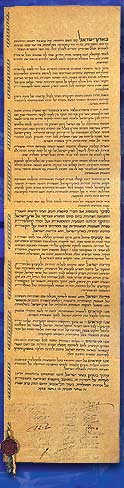
These are the five signatures on my dad's klaf - on his diploma of ordination from Yeshiva University's Rabbi Isaac Elchanan Theological Seminary, which he received in 1942.

The priceless autographs are by five great Torah scholars, Rabbi Binyamin Aronowitz, Rabbi Bernard L. Levinthal of Philadelphia, Rabbi Samuel Belkin, Rabbi Moses Shatzkes (the Lomza Rav) and Rabbi Joseph B. Soloveitchik of Boston (the Rav).

Rabbi Yossi Adler looked at the klaf during the shiva in Teaneck and confirmed what I had been told, that it was rare to have five signatures on such a document. My own ordination has two (Rabbis Belkin and Soloveitchik).


I once asked my dad what it was like to go before these five great rabbis and be examined before receiving semichah - ordination. He told me, "They were tough. They asked difficult questions. They made me sweat."

I greatly treasure this meaningful part of the legacy of my dad.


5/8/22

What were the two worst Jewish prayer decisions?


At its establishment, Chief Rabbi Herzog prescribed that the Prayer for the State of Israel be recited after the Torah reading in the synagogue on Sabbaths and Festivals. This was Jewish prayer mistake number one. He incorrectly mandated that this particular recitation remain unimportant, peripheral, second rate, and really not a part of the davening. It was a quick and dirty innovation. And it was wrong.
  • First off, on account of its placement, the prayer is often recited by the gabbai, not the hazzan.
  • Second, the prayer is frequently recited in a monotone, not chanted, and from the side of the bimah, not from the front and center of the synagogue.
  • Third, the prayer is recited after the Torah reading and before the Musaf service - in a liminal area - between the established parts of the davening. It seems to me to be placed in a tertiary context that makes it even less prominent in the liturgy than the personal mesheberach blessings recited for individuals who receive aliyot to the Torah.
You don't have to be an expert in Jewish liturgy to conclude that this prayer is generally presented as an afterthought, recited quickly, and that it has been pasted in to our davening. In fact in many synagogues, the text is not printed in the prayerbook, It is actually pasted into the back cover of the siddur. It is high time for some prayer-book reform. We ought to be inserting a real prayer for the modern state of Israel into the crux of the actual prayer services of our tradition. We perhaps should have the chazzan chant it properly from the bimah. We perhaps should have the congregation join in responsively or together with the chazzan in singing the prayer with joy. Perhaps we should say this prayer three times a day - every day - in our Amidah or after the Alenu. For sure we must not equivocate about the State of Israel. It is real. We live in Teaneck. Most of our friends have been to Israel. Most of our community members have been inspired by the State and its history. We ourselves have lived there and visited there many times. The State of Israel is a factual, powerful, pervasive, long-lasting creator of religious moods and motivations. Yes it is time to promote the thanksgiving, praise and petition concerning the modern State of Israel as a real and central theme of all of our synagogue prayers. It is time to correct the error of the former Chief Rabbi and promote the Prayer for the State of Israel to a much more prominent place in our liturgy. At its establishment, Chief Rabbi Herzog prescribed that the Prayer for the State of Israel contain the phrase, "the beginning of the blossoming our redemption." This was Jewish prayer mistake number two. The State of Israel is the redemption of the Jewish people. Not the "beginning of the redemption." Not the "beginning of the blossoming of the redemption." It is the actual, historical, theological, political, social and cultural redemption of the Jewish people. Anyone who denies this is not in touch with reality. Anyone who hedges about it with language that is wishy-washy and ambivalent and preliminary - is just a redemption denier. We Jews of all denominations must say the Prayer for the State of Israel more frequently, more centrally and more forcefully. Meanwhile, we do not know how to cure these errors. Here for information purposes, is the current flawed prayer in translation.
Our Father in Heaven, Rock and Redeemer of the people Israel; Bless the State of Israel -- the beginning of the blossoming our redemption. Shield it with Your love; spread over it the shelter of Your peace. Guide its leaders and advisers with Your light and Your truth. Help them with Your good counsel. Strengthen the hands of those who defend our Holy Land. Deliver them; crown their efforts with triumph. Bless the land with peace, and its inhabitants with lasting joy. And visit all our Brethren of the house of Israel, in all the lands where they are scattered, and bring them rapidly to Zion, Your city and to Jerusalem, where Your name lives, as it says in the Torah of Moses, Your servant: ‘Even if your dwelling is at the end of the sky, God will congregate you from there, and bring you from there, and will bring you toward the land that Your forefathers inherited and you will inherit it.’ Dedicate our hearts to love and worship Your name and to keep all that is in Your Torah, and send us the son of David, the Messiah of Your justice, to redeem those who wait for Your salvation. Appear with the glory and the pride of Your strength, in front of all the inhabitants of the Universe, and all those who have breath will say: “The God of Israel is the King, and He reigns over all.” Amen.

[Blogged previously in 4/2007.]

6/30/21

10 Years Ago: Tzvee and Talmud Hullin on the FYI Page 3 of the Jewish Standard

Click to Enlarge
Ten Years Ago: Larry Yudelson of the Jewish Standard of Teaneck wrote me up for their page three FYI column.

The Jewish Standard, Teaneck NJ
July 8, 2011


FYI
Local author puts Talmud translation on the web

As the seven-year cycle of daily Talmud study known as Daf Yomi began a new tractate last month, Tzvee Zahavy found himself running low on blog ideas.

Zahavy, a Teaneck resident, professor and rabbi, is also a blogger.

As the Daf Yomi project approached the beginning of the Babylonian Talmud tractate Hullin, Zahavy realized that he already had content.

"I figured it would be a service both to me in my own studies, and to my readers, if each day for 142 in all, I shared on my blog the text of my English translation of one page of the Talmud text," he said.

Zahavy translated Hullin as part of a series that was completed in 1995 by Professor Zahavy and others, called, "The Talmud of Babylonia. An American Translation." Sales of the set have been modest, in the thousands, he said.

The translation is now available in a new edition from a Christian publisher, Hendrickson, in both print and digital formats.

Artscroll’s English version of the Talmud is better selling, Zahavy said because it is Orthodox-approved and non-academic.

Zahavy said that the general public does not go out in great numbers to buy and read books of and about the Talmud. “Back in the late sixties, author Norman Mailer told us students in a lecture at Yeshiva College that he read the Soncino English Talmud every night at bedtime,” Zahavy said. “We saw that he was trying to impress us and he didn’t. We all knew that the Talmud is always studied seriously - it is never read at bedtime.”

Zahavy’s newest book is called “God’s Favorite Prayers.” The volume will be published in print and digital formats this summer by Talmudic Books, a new imprint that Zahavy started. He is confident that it will sell better than his Talmud translations.“More people pray than study,” he said.

--Larry Yudelson

4/12/21

Yahrzeit of Rav Aharon Lichtenstein, great Torah Sage and the Quintessential Scribe

My teacher and rebbe Rav Aharon Lichtenstein passed away six years ago.

He was awarded the Israel Prize 2014 in Jewish religious literature.

He was one of the finest teachers that I studied with in college - a genius as an educator and a sincere and compassionate human being. He is the person that I chose to personify the quintessential scribe personality of prayer in my book "God's Favorite Prayers (p. 71 ff)." Here is the excerpt.

The Scribe’s Prayers


I had the privilege of studying in Rav Aharon Lichtenstein’s Talmud shiur (class) for two years, 1966-1968. Each December, he invited us talmidim (disciples) to his house for latkes (potato pancakes) on Hanukkah. There, in his apartment, we sat with his little kids and his wife Tovah, daughter of Rav Joseph B. Soloveitchik. The latkes were good and the Lichtensteins appeared to be a regular family. For some reason, that surprised me.

Once, during the years that I was in his shiur, while I was out with some of the guys playing basketball on the courts between the Yeshiva College dorms, Rav Aharon, a lanky, thin and tall man, came walking by. One of us had the chutzpah to ask him to join the ball game. He said okay and he played aggressively—and just like a regular guy. For some reason, that blew my mind.

And, one year, in our student play, the Yeshiva College Purim shpiel, a satiric revue for the holiday, I played the role of Rav Aharon. In my performance, I hemmed and hawed and exaggerated my rebbe’s mannerisms much more than I should have. And there in the audience sat my rebbe, laughing heartily along with us. For some reason, that really blew my mind.

3/25/21

Download Online a Free Passover Seder Haggadah

Here are several of the best places you can go online to download a free Passover Haggadah for your Seder.
I give Chabad credit for a great resource if you want a wide selection of free Hebrew Haggadahs.  
Download Hebrew Haggadahs here.

My new Haggadah is not free - but it is really fantastic!
I thought you might be interested in this new for 2017 reprint of a classic haggadah with a foreword that I added - available from Amazon. - Tzvee

The Polychrome Historical Haggadah                            
The Polychrome Historical Haggadah 
by Jacob Freedman et al.
  Learn more                      
Library Makes 1,000 Rare Haggadahs Available Free Online
An illustration of King David praising G-d in a rare Haggadah published in 1710 in Frankfurt am Maine, Germany

The central Chabad-Lubavitch library in New York made 1,000 Passover Haggadahs, many of them rare, available on the Internet for browsing by the public. The Agudas Chasidei Chabad Library has one of the largest collections of the Passover orders of service in the world.

Housed at the Lubavitch World Headquarters, the library's Haggadah collection began years ago with a nucleus of some 400 volumes purchased on behalf of the Sixth Lubavitcher Rebbe, Rabbi Yosef Yitzchak Schneersohn, of righteous memory, by renowned collector and bibliographer Shmuel Wiener in 1924.

The posting at ChabadLibraryBooks.com represents close to half of the library's total Haggadah collection and is part of chief librarian Rabbi Sholom Ber Levine's goal of making the library more accessible to the public. All told, the library possesses more than 2,200 editions of the Haggadah. Although the rarest of the books, all handwritten, are not yet available, Levine is looking for ways to post them next year. Hebrew Books, directed by Chaim Rosenberg, collaborated on the project.

10/5/20

Jewish Black Magic: They Cursed Ariel Sharon with the Pulsa D'Nora in 2005 - and can it work in October 2020 for someone else?

I've spent years teaching numerous college courses on religion - always with the disclaimer that we will cover only the positive aspects of the subject. Religion used for evil, that is for war or other forms of harm, is a misuse and distortion of systems of faith.

Curses, I reasoned, were a misuse and distortion of religious practice.

Curses invoked before the Rabin assassination changed my mind about that. Prior to that tragic event, on the eve of Yom Kippur, a group of "Kabbalists" intoned the pulsa curse outside the Rabin residence. Once again, in the summer of 2005, another group gathered to invoke the curse against P.M. Ariel Sharon. It seemed to me that curses indeed were part of our religion - like it or not.

One blogger, Canonist, dealt briefly with the curse back in July 2005, complete with a link to the video of the curse "ceremony" and quotations from learned professors:
Praying for Ariel Sharon's Death

Yesterday's death-curse seems thus far to have gone unanswered by the Almighty, but we'll see. Generally speaking, I don't write much about Israel and the disengagement, but this latest is quite interesting. PaleoJudaica's got a great roundup, including descriptions of the pulsa de-nura ceremony, its detractors, and the threat of prosecution that've come out of it. Meantime, you can actually watch the ceremony in this video, which, with a bunch of people in sweats reading from photocopies, looks oddly like some run-of-the-mill Jewish ceremony, like burning chametz or somesuch. The video comes courtesy of Samuel Heilman, via a listserv to which he wrote, with the subject "Jewish Jihadists": "Lest any of you think that only Islamists have jihadists, see the video below in which so-called 'religious Jews' pray for Prime Minister Sharon's Death in a Pulsa De Nura." Bold words on both sides. Let's see what comes of them.
Erudite rabbis have written about the matter, explaining that magic is not a part of Judaism, as in the following:

6/16/20

9 years ago I published: "God’s Favorite Prayers" - it has been a delicious improvement on all previous theologies of Jewish prayers

"God’s Favorite Prayers" (ISBN 0615509495) is a new published book that unlocks the personalities behind the prayers. Author Tzvee Zahavy introduces readers to the archetypes within Jewish liturgy in this engaging new volume.

"God’s Favorite Prayers" invites the reader into the heart of Jewish spirituality, to learn about its idiom and imagery, its emotions and its great sweeping dramas. The author invites the reader to meet six ideal personalities of Jewish prayer and to get to know some of God's favorite prayers.

According to Zahavy, Jews recite and sing and meditate prayers that derive from six distinct archetypes. He labels those six personalities: the performer, the mystic, the scribe, the priest, the meditator and the celebrity.

6/11/20

How to Deal With Facebook Stalkers, List Snubs and Technology Taboo Makers - My Jewish Standard Dear Rabbi Zahavy Column for June 2020


Dear Rabbi Zahavy,

I am on Facebook a lot and have many friends there. Recently, one of those people, whom I have known for many years, started replying negatively on every post that I made and on every comment that I put on Facebook. These were not just critical replies. They were snarky at first, and then became nasty and highly personal in nature.


I unfriended this person. But somehow, he still manages to find and comment on all my posts. What should I do to stop this?

Besieged in Bergenfield


Dear Besieged,

Facebook has mechanisms for actively blocking content from specific individuals. You can and should poke around the platform until you find them, and then invoke the harshest level of blocking against this offending person. Be persistent. Since Facebook thrives on content proliferation, your postings make money for them, and thus it deliberately makes the blocking process possible, but neither easy nor intuitive.

5/3/20

When my Father was Rabbi at the Park East Synagogue

Praying and the synagogue were central to my life since my early childhood. My father, Zev Zahavy, was the rabbi of several distinguished New York City synagogues on the West side and then the East Side of Manhattan. I recall many times accompanying him to his work. His study in the synagogue was off to the side of the main sanctuary, lined with books, filled with a musty smell and having the creakiest wood floor I ever walked on.
The author (right) with his Dad (center) in 5715 in the synagogue sukkah

The synagogue in Manhattan at that time was a stately place with formal services, led by a professional Hazzan. My dad wore a robe and high hat - black during the year and white on the High Holy Days.

He was famous in the city for his sermons. He labored over them for hours. He would send "releases" to the local papers (like the NY Times' 230+ citations of his sermons -- here in online book form) to let them know about what he would be preaching on Saturday. Those were the fifties and the Times and other papers covered the Saturday and Sunday sermons. Frequently we would look around the sanctuary to see if the reporter from the Times was present. We'd know because he'd sit in the back and be writing feverishly on his reporter's pad. (Not iPad... real paper pad.)

My father was ambitious especially about increasing the attendance at the services. We had to count the number of people in shul and discuss that at the lunch table. Then he'd ask us how the sermon was and we all answered enthusiastically every week, "It was terrrrrrific!"

10/5/19

Is Bernie Sanders Jewish?

Yes, Bernie Sanders is a Jew, but the Times (2016) says that, "He Doesn't Like to Talk About It."

I was disappointed in Joseph Berger of the Times for interviewing his brother and not getting Bernie to talk about this.

And trust me, there are dozens of rabbis who would be happy to slam him in the Times for not being a good enough Jew.

The Times didn't give both sides very well and it skipped lightly over the surface of this complex issue

Here is the story:

When Senator Bernie Sanders thanked supporters for his landslide victory in the New Hampshire Democratic primary, he wistfully reminisced about his upbringing as “the son of a Polish immigrant who came to this country speaking no English and having no money.”

While the crowd cheered, Rabbi Michael Paley of New York was among many Jews watching the speech who were taken aback. He said he was surprised that the Vermont senator had not explicitly described his father as a “Polish Jewish immigrant,” a significant distinction given Poland’s checkered history with its Jewish population.

“Nobody in Poland would have considered Bernie a Pole,” Rabbi Paley said.

For 5780 Online Rosh Hashanah and Yom Kippur Kol Nidre services, on Video, on a Live Webcast

Our sincere and heartfelt best wishes to all our readers for a Year of Blessing and Health, Prosperity and Good Cheer.

Rosh Hashanah 5780 - 2019 falls on Monday, the 30th of September and continues for 2 days.

Yom Kippur 5780 - 2019 falls on Wednesday, the 9th of October.

From Central Synagogue in NYC come Rosh Hashanah and Yom Kippur online services and videos. Scroll down to find the feed and schedule. See the LIVE webcast of Kol Nidre services this year.

The 92nd Street Y also plans a webcast of services.

Rabbis on videos at various places discuss atonement and repentance. There also are holiday video recipes for tzimmes, honey cake and tagelach that you can find online.

And see Video-streamed Rosh Hashanah and Yom Kippur Services.

In these coming Days of Awe all of this is good nourishment for the soul.


Purchase some of these wonderful books for the holidays.


6/5/19

Free download files of the Babylonian Talmud in English

I am proud to provide for you as a gift, a download of the complete Babylonian Talmud English translation.

The Talmud in English is online and free at my site, Halakhah.com, http://www.halakhah.com/ - serving up 60,000+ downloads each month.

TRANSLATED INTO ENGLISH WITH NOTES, GLOSSARY AND INDICES UNDER THE EDITORSHIP OF RABBI DR. I. EPSTEIN B.A., Ph.D., D. Lit. FOREWORD BY THE VERY REV. THE LATE CHIEF RABBI DR. J. H. HERTZ. INTRODUCTION BY THE EDITOR.

This set contains the Sedarim (orders, or major divisions) and tractates (books) of the Babylonian Talmud, as translated and organized for publication by the Soncino Press in 1935 - 1948.

My site has the entire Talmud edition in PDF format and  about 8050 pages in HTML format, comprising 1460 files — of the Talmud.

I recommend that on your web site or blog you add a link to this site http://www.halakhah.com.

Highlights include: A formatted 2-column PDF version of the Talmud at Halakhah.com.