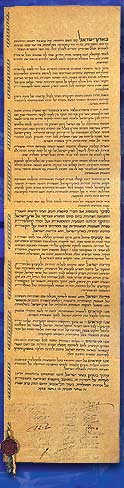
In this paper I examine some common views of scholars concerning the idea of the halakhah in Judaism. I then explain why their methods failed to account for the main philological and historical evidence regarding the term from the Talmudic texts. Then I suggest as a heuristic explanation that the logic of the Talmud defies linearity and can be discussed productively using chaos theory.
1/24/26
Talmudic Chaos v. Halakhic Linearity in the Logic of Judaism
In this paper I examine some common views of scholars concerning the idea of the halakhah in Judaism. I then explain why their methods failed to account for the main philological and historical evidence regarding the term from the Talmudic texts. Then I suggest as a heuristic explanation that the logic of the Talmud defies linearity and can be discussed productively using chaos theory.
11/14/25
Is Caroline Kennedy's Husband Edwin Schlossberg Jewish?
All four of Schlossberg's grandparents were Russian (Ukrainian) Jews born near Poltava and arrived in the United States at Ellis Island.
In 1986 Schlossberg married Caroline Kennedy, the daughter of President John F. Kennedy and Jacqueline Kennedy Onassis at Hyannis Port when Caroline was 28 and Ed was 41.
Their afternoon wedding ceremony was held at the Church of Our Lady of Victory in Centerville, Massachusetts and did not include a mass.
How Jewish is Schlossberg? Nate Bloom refers to "American Legacy: The Story of John and Caroline Kennedy" by C. David Heymann as follows:
Heymann writes that Schlossberg was raised in a "devout Orthodox Jewish family" that belonged to a modern Orthodox synagogue in Manhattan. He attended Hebrew School and had a bar mitzvah ceremony.
9/26/25
A Happy St. Patrick's Day Recollection: When a Little Boy Met the Jewish Lord Mayor of Dublin Ireland

I vividly remember his top hat and the big medal around his neck which swung out at me when he bent down to shake my hand.
It was a grand day for the Jewish and the Irish!
The New York Times wrote up the visit. A wonderful New York story of a previous innocent age.
New York Times. Published: March 17, 1957
BRISCOE ATTENDS PRE-PURIM RITES
Lord Mayor Prays at Altar in Traditional Shawl - Pays Visit to Cardinal
By IRVING SPIEGEL ·
The Lord Mayor of Dublin devoted forty minutes yesterday morning to being plain Robert Briscoe and worshiping in the Orthodox Jewish faith of his ancestors.
He prayed at a Sabbath of Remembrance and pre-Purim service at Congregation Zichron Ephraim, 163 East Sixty-seventh Street. With the prayer shawl he brought with him for the service around his shoulders, he received the Orthodox honor, aliyah - an invitation to the altar.
Then he recited the traditional prayers in Hebrew before and after readings from the Torah. The aliyah was also extended to City Council President Abe Stark and Kings County District Attorney Edward S. Silver, who had of accompanied Mr. Briscoe to the synagogue.
Because of a heavy schedule, Mr. Briscoe and his group did not stay for the entire service. Rabbi Zev Zahavy, spiritual leader of the congregation said that the Lord Mayor's presence at the services was "an inspiration to all Jews in America and throughout the world."
In keeping with the Orthodox custom of not riding on Saturday, the Lord Mayor and his group walked from the Pierre Hotel, where he is staying, to the synagogue. In addition to Mr. Silver and Mr. Stark, Mr. Briscoe was escorted by two detectives of Jewish and Irish extraction, Ely Kerner and John O'Hagan.
Wears Kelly Green Tie
The Lord Mayor wore a cut-away coat, a black topper, a Kelly green tie with a golden harp embroidered in it.
As he strode up Fifth Avenue to attend synagogue services. he passed a group of policemen awaiting their parade assignments and remarked: "Top o' the morning. It's a fine day."
He paused to talk to a group of policewomen. Holding his prayer shawl, he told one young policewoman that, if she saw her commanding officer, "tell him I'm on my way to say my prayers."
Leaving the synagogue, he stopped at Engine Company 39, at 157 East Sixty-seventh Street, and told Lieut Joseph Kennedy, the commander: "No fires today, it's St. Patrick's Day."
Earlier in the morning, he had visited Cardinal Spellman at the Roman Catholic prelate's reidence at 452 Madison Avenue. Mr. Briscoe delivered a personal greeting in behalf of Archbishop John Charles McQuade of Dublin, and gave the Cardinal forty-five sets of Rosary beads, three boxes of chocolates and a glass bowl - all products of Ireland.
Cardinal Spellman told his guest: "There has not been as much excitement here since the Dionne quintuplets." Mr. Briscoe remarked that he was going to attend synagogue services.
"Be sure to leave all those Rosary beads here," the Cardinal replied with a laugh.
Mr. Briscoe laughed. "That's very good, very good," he said.
He returned to the Pierre, but not before being hailed by storekeepers, taxicab drivers and pedestrians. There was a brief rest and then he set out for the synagogue. Mr. Briscoe had originally intended to attend services at Congregation Rodeph Sholom on West Eighty-third Street but decided against it because of the long walk.
He returned to the hotel at noon for a brief visit with James A. Farley, chairman of the parade, and out again - this time for the St. Patrick's Day Parade with a ringing declaration of: "What a beautiful day!"
4/27/25
Transgender Kids, Covert Convert Bat Mitzvah and Vintage Necktie Aliyah Quandary - Dear Rabbi Zahavy - Your Jewish Standard Talmudic Advice for July 2017 (A classic oldie but goodie column!)
Dear Rabbi Zahavy,
I recently asked my friend how her young grade-school kids — a boy and girl — were doing. She replied that they are fine, and they have new names. The boy now has a girl’s name and the girl has a boy’s name. I asked why? She matter-of-factly replied that they both are transgender.
I was dumbfounded to hear this. I said nothing to her. Should I ask her more about this? Should I discuss this with a responsible authority?
Worried About Trans Kids
Dear Worried,
Yes, you have every right to ask the parent for more details, and to seek out, with sensitivity, more information on this topic from friends or experts or from your own counselors. The mother makes no secret of the facts. She is open and proud of her children and their gender identities.
Gender dysphoria is a seriously hot topic this year in social and political discussions, and in the media (2017). You will find many experts and pundits out there willing to share advice and counsel on the subject.
4/14/24
Understanding the Extensive Connections Between Religions and Terrorism?
What are the connections between religions and terrorism?
- Questions about American Christian Terrorism
- Religion and Jewish Terrorists (and see the JTA report)
- What is a Religious Culture of Violence and Terror?
- Who were Shoko Asahara and the Buddhist Aum Shinrikyo Religious Terrorists?
- How did Religion Motivate Sikh Terrorists?
- What is the Logic of the Theater of Religious Terror?
- Why Do Religious Terrorist Martyrs say that they aim to kill the demons?
- What do Sexuality and Humiliation have to do with Terrorism?
- Will the War Against Religious Terrorism Ever End?
- From Kahane to Osama: How Do Men Make Religious Terrorism Into Cosmic War?
- How can we end religious terrorism and achieve the peace of God?
- Concluding Questions on Religion and Terrorism
9/15/23
My Jewish Standard Dear Rabbi Zahavy Column for October 2016: Binging at Weddings and Not Believing in Sin
Binging at Weddings and Not Believing in Sin
Dear Rabbi Zahavy,
I went to a big Orthodox Jewish family wedding recently in Williamsburg, Brooklyn. The music was so loud that some of my relatives, who had expected it, brought along earplugs. There was so much food at the smorgasbord and the main meal that the next day I weighed myself and saw I had gained more than three pounds in one night.
I’m tempted to turn down invitations to future frum family simchas just to keep my hearing intact and my waistline under control. Is that a reasonable course of action?
Binging in Bergenfield
Dear Binging,
Sure you can skip family weddings to preserve your health and well-being, and you should do that if you have no other solution. But some of your kin seem to have found modalities that allow them to participate and preserve their hearing. Surely ear plugs are an option for you too. Why not avail yourself of them?
And regarding the food, you know that you do not have to eat all of it! One possible alternative is to attend the smorg and the chuppah and gracefully decline the elaborate dinner that follows. Who needs to drive home at midnight from Brooklyn anyway? Of course, doing that you will miss the chance to bond and share at greater length with your family. But with such loud bands, how much schmoozing could you do with the relatives anyway?
9/10/23
My Puffin Foundation Lecture on Religion and Terrorism
10/9/22
Electricity on Shabbat? My Dear Rabbi Zahavy Jewish Standard Column for March 2020
Dear Rabbi Zahavy,
Members of my community of Orthodox Jews who are shomer Shabbos refrain from turning on and off all electrical devices to observe their Shabbat rest. So, on Friday nights and Saturdays our practice is not to use, for instance, our phones or TVs or computers. And we don’t turn on or off lights or fans or heaters.
Lately, I’ve become lax in keeping these rules, especially regarding my use of my smart phone, my computer and my Alexa Amazon Echo devices. I feel that using these devices enhances my rest and my leisure. And I have found that avoiding them makes me uneasy, not relaxed or restful.
Get The Jewish Standard Newsletter by email and never miss our top storiesFREE SIGN UP
I don’t publicly advertise my actions. But it’s increasingly evident to me that my family knows what I am doing and that they quietly disapprove.
I am worried and need your advice. Am I sinning by my behavior? I feel strongly that what I am doing is not a violation of any rules and likely will continue my uses. But what can I do regarding my actions if this all blows up and causes social friction in my family and community?
Electrified in Englewood
Dear Electrified,
Establishing sacred time is a powerful part of all religions. The notion that we Jews spend one day a week in a special world of restful restrictions starting on sundown on Friday is an amazing claim to make. And at the same time, it is hard for the community to enforce the Sabbath taboos.
9/28/22
Can a Jew Pray Directly to the Divine Attribute of Compassion?
“Lord, Lord, God, Compassionate, with loving kindness, patient, with kindness and truth; keeper of mercy for thousands, forgiver of iniquity, transgression and sin; clearing us. Forgive our iniquity and sin and accept us.” (cf. Exodus 34:6-7)
Within this sequence of repeated meditations, the tenth century Italian payetan Rabbi Amitai ben Shepatiah presents in his prayer a direct appeal to the divine attribute of compassion to intercede for us:
Attribute of compassion, pour upon us
In the presence of your creator, cast our supplications
For the sake of your people, request compassion
For every heart has pain and every mind is ill
(Goldschmidt, YK, p. 778)
9/11/22
Will the War Against Religious Terrorism Ever End?
Mark Juergensmeyer, in Terror in the Mind of God, lays out five ways that the reign of religious terror can come to an end. Let's consider each. First consider the end will come with the forceful eradication of the terrorists, what appears to have been the US response to the 9/11 attacks, continued with the more recent killing of OBL.
Juergensmeyer outlines,
7/18/22
Shall we fast and mourn on Tisha B'Av? No!
Now before you convene a synod to excommunicate me, know that I am in good company. In the third century CE the greatest Tanna, Rabbi Judah the Prince, tried to abolish Tisha B'Av.
My son Yitz called my attention to this passage below which records the rabbi's action [Soncino Babylonian Talmud (2012-04-25). Megillah and Shekalim (Kindle Locations 739-743). Kindle Edition.] and to Tosafot's glosses (at Megillah 5b) which reject the premise that someone could entertain the notion of abolishing Tisha B'Av.
R. Eleazar said in the name of R. Hanina: Rabbi planted a shoot on Purim, and bathed in the [bathhouse of the] marketplace of Sepphoris on the seventeenth of Tammuz and sought to abolish the fast of the ninth of Ab, but his colleagues would not consent. R. Abba b. Zabda ventured to remark: Rabbi, this was not the case. What happened was that the fast of Ab [on that year] fell on Sabbath, and they postponed it till after Sabbath, and he said to them, Since it has been postponed, let it be postponed altogether, but the Sages would not agree.Of course, if Rabbi Judah the Prince (compiler of the Mishnah) once tried to abolish Tisha B'Av but the sages would not agree to it, I do not expect that the sages of our times will agree with me to abolish Tisha B'Av.
Yet here is why they should.
I concur that as a culture we need to remember the calamities of the past so that we can be vigilant and prevent the calamities of the future. But we need effective ritual memories that are clear and unequivocal. Tisha B'Av commemorates that the city of Jerusalem and the Temple in it were destroyed.
Because the city has been rebuilt in modern Israel, this befogs the symbolism of the past destruction and renders it less effective.
I have been mulling over this issue for thirty years or more. In 2012 I mused as follows (with a few edits added).
Is Tisha B'Av relevant? No I do not think that the fast of Tisha B'Av is relevant anymore. I need a holiday from Tisha B'Av.
That day was for a long time a commemoration through fasting and prayer over the destroyed city of Jerusalem and the Temple. I visited Jerusalem in May of 2011 (ed.: and again in 2013, and many more times since then) and can attest that the city is not desolate. It is without reservations, glorious.
Who then wants the bleak story to be told? Archetypally the militant "celebrity" archetype wants to keep recalling defeat, destruction and desolation, to spur team Jews on to fight the foes and to triumph at the end of time. That scheme may work for that archetype as long as the facts of reality do not fly smack in the face of the narrative. And when they do, what then? The narrative loses its force. It becomes absurd.
I cannot imagine Jerusalem in ruins. Period. And indeed, why should I perpetuate an incendiary story of gloom and doom into a diametrically opposite positive world of building and creativity? The era of desolation has ended.
For over twenty-five years, I've been lamenting the irony of lamenting over a city that is rebuilt. It's more rebuilt now -- way more -- than it was twenty five plus years ago. What do I do then about Tisha B'Av, the Jewish fast day of lament and mourning? Here is what I said those many years ago.
11/28/21
Happy Hanukkah. But what is Hanukkah?
If you are wondering what is the official meaning of Hanukkah as presented in Jewish liturgy, here is the text we insert for the holiday, no spin added,
And [we thank You] for the miracles, for the redemption, for the mighty deeds, for the saving acts, and for the wonders which You have wrought for our ancestors in those days, at this time.
In the days of Matityahu, the son of Yochanan the High Priest, the Hasmonean and his sons, when the wicked Hellenic government rose up against Your people Israel to make them forget Your Torah and violate the decrees of Your will.
But You, in Your abounding mercies, stood by them in the time of their distress. You waged their battles, defended their rights, and avenged the wrong done to them. You delivered the mighty into the hands of the weak, the many into the hands of the few, the impure into the hands of the pure, the wicked into the hands of the righteous, and the wanton sinners into the hands of those who occupy themselves with Your Torah.
You made a great and holy name for Yourself in Your world, and effected a great deliverance and redemption for Your people Israel to this very day. Then Your children entered the shrine of Your House, cleansed Your Temple, purified Your Sanctuary, kindled lights in Your holy courtyards, and instituted these eight days of Hanukkah to give thanks and praise to Your great Name.
And then of course the Talmud explains Hanukkah. Sorta.
The Talmud (Bavli Shabbat 21b) explains what is Hanukkah:
What is Hanukkah? For our Rabbis taught: On the twenty-fifth of Kislev commence the days of Hanukkah, which are eight on which a lamentation for the dead and fasting are forbidden.
For when the Greeks entered the Temple, they defiled all the oils therein, and when the Hasmonean dynasty prevailed against and defeated them, they made search and found only one cruse of oil which lay with the seal of the High Priest, but which contained sufficient for one day's lighting only; yet a miracle was wrought therein and they lit the lamp therewith for eight days.
The following year these days were appointed a Festival with the recital of Hallel and thanksgiving.
What else is there to say?
Dreidls, gelt, and latkes come later.
Our Amazing Incredible Hanukkah Avatar
Hanukkah has its own avatar. I wrote about how this works in my truly amazing favorite book, "God's Favorite Prayers."6/30/21
10 Years Ago: Tzvee and Talmud Hullin on the FYI Page 3 of the Jewish Standard
![]() |
| Click to Enlarge |
The Jewish Standard, Teaneck NJ
July 8, 2011
FYI
Local author puts Talmud translation on the web
As the seven-year cycle of daily Talmud study known as Daf Yomi began a new tractate last month, Tzvee Zahavy found himself running low on blog ideas.
Zahavy, a Teaneck resident, professor and rabbi, is also a blogger.
As the Daf Yomi project approached the beginning of the Babylonian Talmud tractate Hullin, Zahavy realized that he already had content.
"I figured it would be a service both to me in my own studies, and to my readers, if each day for 142 in all, I shared on my blog the text of my English translation of one page of the Talmud text," he said.
Zahavy translated Hullin as part of a series that was completed in 1995 by Professor Zahavy and others, called, "The Talmud of Babylonia. An American Translation." Sales of the set have been modest, in the thousands, he said.
The translation is now available in a new edition from a Christian publisher, Hendrickson, in both print and digital formats.
Artscroll’s English version of the Talmud is better selling, Zahavy said because it is Orthodox-approved and non-academic.
Zahavy said that the general public does not go out in great numbers to buy and read books of and about the Talmud. “Back in the late sixties, author Norman Mailer told us students in a lecture at Yeshiva College that he read the Soncino English Talmud every night at bedtime,” Zahavy said. “We saw that he was trying to impress us and he didn’t. We all knew that the Talmud is always studied seriously - it is never read at bedtime.”
Zahavy’s newest book is called “God’s Favorite Prayers.” The volume will be published in print and digital formats this summer by Talmudic Books, a new imprint that Zahavy started. He is confident that it will sell better than his Talmud translations.“More people pray than study,” he said.
--Larry Yudelson
3/25/21
Download Online a Free Passover Seder Haggadah
- The Jewish Agency Haggadah Links
- Wikisource Hebrew Haggadah Page
- The Union Haggadah (CCAR Classical Reform)
- Haggadah According to the Rite of Yemen: with the Arabic-Hebrew
- The Kol Menachem Haggadah: Nusach Haarizal, by Chaim Miller
Download Hebrew Haggadahs here.
My new Haggadah is not free - but it is really fantastic!
|
|
|
| An illustration of King David praising G-d in a rare Haggadah published in 1710 in Frankfurt am Maine, Germany |
The central Chabad-Lubavitch library in New York made 1,000 Passover Haggadahs, many of them rare, available on the Internet for browsing by the public. The Agudas Chasidei Chabad Library has one of the largest collections of the Passover orders of service in the world.
Housed at the Lubavitch World Headquarters, the library's Haggadah collection began years ago with a nucleus of some 400 volumes purchased on behalf of the Sixth Lubavitcher Rebbe, Rabbi Yosef Yitzchak Schneersohn, of righteous memory, by renowned collector and bibliographer Shmuel Wiener in 1924.
The posting at ChabadLibraryBooks.com represents close to half of the library's total Haggadah collection and is part of chief librarian Rabbi Sholom Ber Levine's goal of making the library more accessible to the public. All told, the library possesses more than 2,200 editions of the Haggadah. Although the rarest of the books, all handwritten, are not yet available, Levine is looking for ways to post them next year. Hebrew Books, directed by Chaim Rosenberg, collaborated on the project.
1/14/21
Resources in the analysis of the connections between terrorism and religion
Here is a linked guide to my substantial blog posts of study resources in the analysis of the connections between terrorism and religion.
- Questions about American Christian Terrorism
- Marginality, sexual despair, political powerlessness, masculinity and terrorism
- Religion and Jewish Terrorists
- What is a Religious Culture of Violence and Terror?
- Who were Shoko Asahara and the Buddhist Aum Shinrikyo Religious Terrorists?
- How did Religion Motivate Sikh Terrorists?
- What is the Logic of the Theater of Religious Terror?
- Why Do Religious Terrorist Martyrs say that they aim to kill the demons?
- What do Sexuality and Humiliation have to do with Terrorism?
- Will the War Against Religious Terrorism Ever End?
- From Kahane to Osama: How Do Men Make Religious Terrorism Into Cosmic War?
- How can we end religious terrorism and achieve the peace of God?
- Concluding Questions on Religion and Terrorism
12/16/20
The Celebrity Archetype in Jewish Prayer: A chapter from my book "God's Favorite Prayers"
The
Celebrity’s Prayers
Aleinu
(Hebrew: עָלֵינוּ, “upon us”) or Aleinu leshabei'ach (“[it is] upon us to praise [God]”), meaning
“it is upon us or it is our obligation or duty to praise God.” A Jewish prayer
recited at the end of each of the three daily services. It is also recited
following the New Moon blessing and after a circumcision is performed.
—Wikipedia, Aleinu
|
M |
y
quest for perfect prayer and for spiritual insights evolved, not just at
synagogues on the ground but also one time during my davening on
a jumbo jet flight at an altitude of 39,000 feet and a speed of 565 miles per
hour. That is where, by happenstance on an airplane in 1982, I met Rabbi Meir
Kahane, an American-Israeli Orthodox rabbi, an ultra-nationalist writer and
political figure and, later, a member of the Israeli Knesset.
I recognized Kahane
right away when I saw him on the flight. He was a famous New York Jew. In the
1960s and 70s, Kahane had organized the Jewish Defense League (JDL). Its goal
was to protect Jews in New York City's high-crime neighborhoods and to instill
Jewish pride. Kahane also was active in the struggle for the rights of Soviet
Jews to emigrate from Russia and to immigrate to Israel. By 1969, he was
proposing emergency Jewish mass-immigration to Israel because of the imminent
threat he saw of a second Holocaust in an anti-Semitic United States. He argued
that Israel be made into a state modeled on Jewish religious law, that it annex
the West Bank and Gaza Strip and that it urge all Arabs to voluntarily leave
Israel or to be ejected by force.
It was then, by coincidence, that I traveled with Kahane on a long Tower Air flight to Israel. As was common on flights to Israel, a few hours after takeoff, Jewish men gathered at the back of the plane. As the sun became visible in the Eastern sky, they formed a minyan, kind of an ad hoc synagogue. In this unusual and somewhat mystical setting, I prayed the morning services with the rabbi and others at the back of the jumbo jet.
7/23/20
Pandemic Lamentations: My Jewish Standard Dear Rabbi Zahavy Column for July 2020
These past few months in 2020 have been such a sad time of worldwide suffering, specifically due to the impact of the covid-19 virus. On the upcoming Tisha B’Av fast day (the ninth day of Av, which this year begins on the evening of July 29 and ends at sundown on July 30), would it be appropriate to make note of what is going on around us and perhaps to recite prayers to lament and to seek consolation for our present sufferings? How would that work for us?
Lamenting in Leonia
Dear Lamenting,
Yes, that surely is appropriate to do. Though our world of 2020 seems distant from the ancient times of Tisha B’Av, in 70 C. E., when Jerusalem and the Temple were destroyed, the underlying human conditions of life have not changed. Sadly, this year we have come to the point where right now we face extraordinary suffering, trauma, and destruction, on the personal, communal, and global level.
To make for yourself a meaningful Tisha B’Av 2020, you will need to creatively repurpose our old and established rituals, which were instituted after the destructions of 70 C.E. Under the circumstances, you should go for it, and create a new set of lamentations for yourself.
6/16/20
9 years ago I published: "God’s Favorite Prayers" - it has been a delicious improvement on all previous theologies of Jewish prayers
"God’s Favorite Prayers
According to Zahavy, Jews recite and sing and meditate prayers that derive from six distinct archetypes. He labels those six personalities: the performer, the mystic, the scribe, the priest, the meditator and the celebrity.