Showing posts with label universities. Show all posts

1/24/26

Talmudic Chaos v. Halakhic Linearity in the Logic of Judaism

In 2011 I published an article, "In Search Of The Logic Of Judaism: From Talmudic Chaos To Halakhic Linearity," which you can download and read from the link here.   


I used mathematical ideas to differentiate the linear organization of the halakhah from non-linear thinking of the Talmud. Our abstract says: 

In this paper I examine some common views of scholars concerning the idea of the halakhah in Judaism. I then explain why their methods failed to account for the main philological and historical evidence regarding the term from the Talmudic texts. Then I suggest as a heuristic explanation that the logic of the Talmud defies linearity and can be discussed productively using chaos theory.

The authors in this volume cover varied topics with sophistication and erudition. The publisher's page provides details about the book, as copied below. 

7/10/24

Yahrzeit of my mother Edith Zahavy

We are observing today the 26th Yahrzeit of my mother Edith Zahavy (aleha hashalom).

We miss her so very much. She would have loved to see the progress of her children and grandchildren and great-grandchildren, and take pride in all of their accomplishments. She would have loved to read books to her great-grandchildren and to watch them play and grow.

She was born in NYC and attended the public schools in Washington Heights. She watched from her classroom window as they built the George Washington Bridge.

She graduated from Hunter High School, Hunter College and went on to a career in public service at the OPA and then into the field education. 

Together with my dad, she founded the Park East Day School when my father was rabbi at the Park East Synagogue, then called Congregation Zichron Ephraim. She subsequently taught in NYC public schools for many years.

She is interred on Har Hamenuchot in Jerusalem. Her beautiful memorial photo site is here.

4/14/24

Understanding the Extensive Connections Between Religions and Terrorism?

In light of the awful terrorist attacks that have been launched once again in Israel I thought it urgent to repost this item.

What are the connections between religions and terrorism? 

That's a big question. I tried to answer, explain and understand it in the past through my extensive scholarly research and my academic teaching.

Here is a selected list of my blog posts of study resources in the analysis of the connections between terrorism and religion (compiled when I taught a course on religion and terrorism at FDU a few years ago). Click on each one to read it.
  1. Questions about American Christian Terrorism
  2. Religion and Jewish Terrorists (and see the JTA report)
  3. What is a Religious Culture of Violence and Terror? 
  4. Who were Shoko Asahara and the Buddhist Aum Shinrikyo Religious Terrorists? 
  5. How did Religion Motivate Sikh Terrorists? 
  6. What is the Logic of the Theater of Religious Terror? 
  7. Why Do Religious Terrorist Martyrs say that they aim to kill the demons? 
  8. What do Sexuality and Humiliation have to do with Terrorism? 
  9. Will the War Against Religious Terrorism Ever End? 
  10. From Kahane to Osama: How Do Men Make Religious Terrorism Into Cosmic War? 
  11. How can we end religious terrorism and achieve the peace of God? 
  12. Concluding Questions on Religion and Terrorism

I have studied this subject at great length and taught courses in the area because I believe that understanding can help us resolve tragic conflicts. 
I also believe in the power of prayer to help us bring peace to the world.
I recommend to you all of my books: My Home Page

7/18/22

Shall we fast and mourn on Tisha B'Av? No!

No. I believe we should abolish the practice of fasting to commemorate the destruction of the Jerusalem Temple on the ninth day of the month of Av, known as Tisha B'Av.

Now before you convene a synod to excommunicate me, know that I am in good company. In the third century CE the greatest Tanna, Rabbi Judah the Prince, tried to abolish Tisha B'Av.

My son Yitz called my attention to this passage below which records the rabbi's action [Soncino Babylonian Talmud (2012-04-25). Megillah and Shekalim (Kindle Locations 739-743). Kindle Edition.] and to Tosafot's glosses (at Megillah 5b) which reject the premise that someone could entertain the notion of abolishing Tisha B'Av.
R. Eleazar said in the name of R. Hanina: Rabbi planted a shoot on Purim, and bathed in the [bathhouse of the] marketplace of Sepphoris on the seventeenth of Tammuz and sought to abolish the fast of the ninth of Ab, but his colleagues would not consent. R. Abba b. Zabda ventured to remark: Rabbi, this was not the case. What happened was that the fast of Ab [on that year] fell on Sabbath, and they postponed it till after Sabbath, and he said to them, Since it has been postponed, let it be postponed altogether, but the Sages would not agree.
Of course, if Rabbi Judah the Prince (compiler of the Mishnah) once tried to abolish Tisha B'Av but the sages would not agree to it, I do not expect that the sages of our times will agree with me to abolish Tisha B'Av.

Yet here is why they should.

I concur that as a culture we need to remember the calamities of the past so that we can be vigilant and prevent the calamities of the future. But we need effective ritual memories that are clear and unequivocal. Tisha B'Av commemorates that the city of Jerusalem and the Temple in it were destroyed.

Because the city has been rebuilt in modern Israel, this befogs the symbolism of the past destruction and renders it less effective.

I have been mulling over this issue for thirty years or more. In 2012 I mused as follows (with a few edits added).

Is Tisha B'Av relevant? No I do not think that the fast of Tisha B'Av is relevant anymore. I need a holiday from Tisha B'Av.

That day was for a long time a commemoration through fasting and prayer over the destroyed city of Jerusalem and the Temple. I visited Jerusalem in May of 2011 (ed.: and again in 2013, and many more times since then) and can attest that the city is not desolate. It is without reservations, glorious.

Who then wants the bleak story to be told? Archetypally the militant "celebrity" archetype wants to keep recalling defeat, destruction and desolation, to spur team Jews on to fight the foes and to triumph at the end of time. That scheme may work for that archetype as long as the facts of reality do not fly smack in the face of the narrative. And when they do, what then? The narrative loses its force. It becomes absurd.

I cannot imagine Jerusalem in ruins. Period. And indeed, why should I perpetuate an incendiary story of gloom and doom into a diametrically opposite positive world of building and creativity? The era of desolation has ended.

For over twenty-five years, I've been lamenting the irony of lamenting over a city that is rebuilt. It's more rebuilt now -- way more -- than it was twenty five plus years ago. What do I do then about Tisha B'Av, the Jewish fast day of lament and mourning? Here is what I said those many years ago.

4/12/21

Yahrzeit of Rav Aharon Lichtenstein, great Torah Sage and the Quintessential Scribe

My teacher and rebbe Rav Aharon Lichtenstein passed away six years ago.

He was awarded the Israel Prize 2014 in Jewish religious literature.

He was one of the finest teachers that I studied with in college - a genius as an educator and a sincere and compassionate human being. He is the person that I chose to personify the quintessential scribe personality of prayer in my book "God's Favorite Prayers (p. 71 ff)." Here is the excerpt.

The Scribe’s Prayers


I had the privilege of studying in Rav Aharon Lichtenstein’s Talmud shiur (class) for two years, 1966-1968. Each December, he invited us talmidim (disciples) to his house for latkes (potato pancakes) on Hanukkah. There, in his apartment, we sat with his little kids and his wife Tovah, daughter of Rav Joseph B. Soloveitchik. The latkes were good and the Lichtensteins appeared to be a regular family. For some reason, that surprised me.

Once, during the years that I was in his shiur, while I was out with some of the guys playing basketball on the courts between the Yeshiva College dorms, Rav Aharon, a lanky, thin and tall man, came walking by. One of us had the chutzpah to ask him to join the ball game. He said okay and he played aggressively—and just like a regular guy. For some reason, that blew my mind.

And, one year, in our student play, the Yeshiva College Purim shpiel, a satiric revue for the holiday, I played the role of Rav Aharon. In my performance, I hemmed and hawed and exaggerated my rebbe’s mannerisms much more than I should have. And there in the audience sat my rebbe, laughing heartily along with us. For some reason, that really blew my mind.

6/5/20

Are dirty tricks in negotiations kosher?

Day after day we see ill will and bad faith in the negotiations in our marketplace and workplace.

No, dirty tricks are not kosher.

But you ask, exactly what are dirty tricks and how can you deal with them?

Several years ago we took one course in Negotiations in the MBA program at Rutgers. Each year the brilliant professor who taught the course, Daniel Levin sends emails to his former students to remind them about how to respond in a negotiation to the prevalent issue of distributive tactics or what we normally call "dirty tricks."

According to Levin, the top ten dirty tricks in negotiations are:
1. Good Cop/Bad Cop
2. Emotional Intimidation
3. Lowball (or Highball) Offer
4. Opening with a Take It or Leave It Offer
5. Exploiting the Trappings of Power
6. Increasing an Offer's Appearance of Legitimacy
7. Pretending to Have Limited Authority
8. Playing a Game of Chicken
9. Lying about Priorities
10. Nibbling
Levin gives us his priceless suggestions for responses in his Talmudic analysis here. Study it and study it some more, because everything you need to know about dirty tricks is in that grid.

We've said many times that in all of the years of our education through college and rabbinical school and graduate school at Brown, Levin's negotiations course in the MBA program at Rutgers was the most valuable course that we ever took.

We use the skills that we learned there every day.

Thank you again Dan Levin.

9/5/19

My Jewish Standard Dear Rabbi Zahavy column for September 2019 - Your talmudic advice column - What should I do about our tribal rituals and knowledge

My Jewish Standard Dear Rabbi Zahavy column for September 2019
Your Talmudic advice column
What should I do about our tribal rituals and knowledge

Dear Rabbi Zahavy,

I was shocked to read an op-ed in an Israeli newspaper by a writer who made radical assertions — seemingly without much evidence to support his assertions — that circumcision (bris milah) was not a central ritual of ancient Israel. The writer, moreover, proposed eliminating circumcision from Judaism, seemingly reflecting his blindness to his own Jewish culture and religion. Is eliminating circumcision now a trend among some secularist Jews? What can we do to stop this trend?

Bris Defender in Bergenfield


Dear Defender,

While many Jews assume that circumcision is a universal practice among their fellow Jews, that has not always been entirely true. In the early days of Reform Judaism in the 19th century, some classical Reform Jews openly opposed all rituals, including circumcision. And today, as you suspect, there are some young Jewish Israeli parents who refuse to circumcise their sons.

I have a devout Jewish friend who was terribly upset when her son in Israel did not circumcise her new grandson last year. I observe that it is trendy now in some progressive communities in Israel not to circumcise baby boys.

The article you cited provides some rationalizations for those people, but it is based on dubious historical claims.

7/11/19

Finding Your Existentialist Judaism - Your Jewish Standard Talmudic Advice Dear Rabbi Zahavy Column for July 2019

Your Jewish Standard Talmudic Advice Dear Rabbi Zahavy Column for July 2019

Dear Rabbi Zahavy,

These days I am increasingly unsure of the nature of my Judaism — my religious identity. I know for sure that I am a Jew. Both my parents were Jewish. And I do observe the Jewish festivals and Sabbaths, but now not so rigorously or in accord with any single denomination. I find it more and more difficult to define my affiliation with any specific organized Jewish group. Some of my friends politely tell me that I need to decide where I stand and conform to the beliefs and standards of one of the forms of Judaism. I just don’t know that I can do that anymore. I do want to explore Judaism philosophically, but I don’t know where to start. What is your advice?

Drifting in Demarest


Dear Drifting,

Most folks cannot tolerate too much ambiguity. They look for certainty. It sounds like you are living with uncertainty in your identification with Judaism. And while in our society it is rare for people to overtly butt into other people’s lives and life choices, some of your friends must sense your unease. That’s why they are chiming in that you need to decide.

It is reasonable for people to want to know where their friends and relatives stand regarding Judaism. And they want a label to name your choice and to make the identification clear: Orthodox, Conservative, Reform, Reconstructionist, chasidic, Lubavitch; and in Israel there are category labels like dati, chiloni, Dati Leumi, charedi.

10/5/18

Are you a hedgehog or a fox?

My teacher in college c. 1971 in a seminar at the Bernard Revel Graduate School mentioned a book by Isaiah Berlin with great enthusiasm. He then applied the concept of the two archetypes, hedgehog and fox, to describe the nature of the work of two medieval rabbis (I forget which ones, but I'll wager he said Rabbenu Tam was a hedgehog and maybe Rashi was a fox.)

So I went over to the library and read the book, as I often did when one of my teachers mentioned a volume with high praise.

The other day at the office I tried to explain the archetypes to a talented programmer, noting after summarizing Berlin's theory that said developer came across as a hedgehog. And right then I realized that apparently I had lapsed into speaking Aramaic - or that was the look I got from my colleague.

Wikipedia has a nice precis of the book (it's just an essay really of 90 or so pages which is here in a PDF)...
"The Hedgehog and the Fox" is the title of an essay by Isaiah Berlin, regarding the Russian author Leo Tolstoy's theory of history.

The title is a reference to a fragment attributed to the ancient Greek poet Archilochus: πόλλ' οἶδ ἀλώπηξ, ἀλλ' ἐχῖνος ἓν μέγα ("The fox knows many things, but the hedgehog knows one big thing"). In Erasmus Rotterdamus's Adagia from 1500, the expression is recorded as Multa novit vulpes, verum echinus unum magnum.)

Berlin expands upon this idea to divide writers and thinkers into two categories: hedgehogs, who view the world through the lens of a single defining idea (examples given include Dante, Plato, Lucretius, Pascal, Hegel, Dostoevsky, Nietzsche, Ibsen, and Proust) and foxes who draw on a wide variety of experiences and for whom the world cannot be boiled down to a single idea (examples given include Shakespeare, Herodotus, Aristotle, Montaigne, Erasmus, Molière, Goethe, Pushkin, Balzac, Joyce, Anderson).

Turning to Tolstoy, Berlin contends that at first glance, Tolstoy escapes definition into one of these two groups. He postulates, rather, that while Tolstoy's talents are those of a fox, his beliefs are that one ought to be a hedgehog, and thus Tolstoy's own voluminous assessments of his own work are misleading. Berlin goes on to use this idea of Tolstoy as a basis for an analysis of the theory of history that Tolstoy presents in his novel War and Peace.

The essay has been published separately and as part of the collection Russian Thinkers, edited by Henry Hardy and Aileen Kelly.

Some authors, for instance Michael Walzer, have used the same pattern of description on Berlin, as a person who knows many things, compared to the purported narrowness of many other contemporary political philosophers. Berlin's former student, Canadian philosopher Charles Taylor, has been dubbed a hedgehog by Berlin and readily admits to it in an interview after receiving the 2007 Templeton Prize.

Berlin expanded on this concept in the 1997 book The Proper Study of Mankind. Philip Tetlock, a political psychology professor in the Haas Business  school at UC, Berkeley, draws heavily on this distinction in his exploration of the accuracy of experts and forecasters in various fields (especially politics) in his 2005 book Expert Political Judgment: How Good Is It? How Can We Know?.
You can read the first ten pages or so at Questia or here. Or the whole essay here.

And now we must ask, Are you a hedgehog or a fox? Choose!
(reposted from 7/08)

7/18/18

Times: Bruce Lincoln et. al. say NIMBY to University of Chicago Center for Milton Friedman Economics

10 years ago 7/12/2008 - this is what was on my mind... a blast from the past.... It looks like the opposition of a decade ago failed to stop the project - see the link here to the Becker Friedman Institute about page and activities summary.

Repost from 2008 follows:

Apparently, my old colleague Bruce Lincoln is leading the opposition at the University of Chicago to a newly established Center for Milton Friedman Style Economics.

The Chi Trib quoted Lincoln last month, '"It is a right-wing think tank being put in place," said Bruce Lincoln, a professor of the history of religions and one of the faculty members who met with the administration Tuesday. "The long-term consequences will be very severe. This will be a flagship entity and it will attract a lot of money and a lot of attention, and I think work at the university and the university's reputation will take a serious rightward turn to the detriment of all."'

Now the Times
(in a notably weak and poorly researched article) has him saying less, that is, "As an opponent of the entire institute, rather than simply its name, Mr. Lincoln characterized himself on the extreme end of the opposition. He said he would like to see a research center “much more committed to free inquiry and a larger debate, and not just grinding the same ax sharper and sharper.”"

3/8/18

What made Rav Soloveitchik a simply great Talmud teacher

It's now 25 years since my renowned teacher, Rav Soloveitchik, passed away.

When I published this short essay in 2005 in the Commentator, the YU undergraduate newspaper, I was proud to extol my rebbe in the most glowing terms I could imagine. After further review, as they say in the NFL, I still feel that way. I republished this in honor of the Yeshiva University Chag HaSemikhah Convocation that took place on Sunday, March 19, 2017. I received my rabbinic ordination from Yeshiva in 1973. My father received his rabbinic ordination from Yeshiva March 19, 1942.

Here again is my meager and utterly inadequate tribute to a truly great man.

R. Joseph B. Soloveitchik: Indelible Beginner

In the fall of 1969, as a college senior, I started four years of learning in Rabbi J. B. Soloveitchik's Talmud shiur.  In my family we venerated the Rav above all other rabbis. We spoke of him with the utmost reverence that one would bestow only upon a truly saintly man.

I received in those four years so much from the Rav: a methodology of learning, a theology of Judaism and, above all, a secret of pedagogy.

Let me explain briefly this last point. The Rav would sometimes in an occasional moment of surprising self-reflection refer to himself as a "poshutte melamed," just a teacher of beginners. That statement puzzled me. Surely the Rav was the greatest sage of our generation. How could he represent himself in this ordinary way?

One day I accidentally discovered what he meant. We convened on the fourth floor classroom for our shiur - about to begin studying a famous sugya in Massechet Shabbat. That day I was using a Talmud volume from a small shas that my uncle had used when he studied in the Rav's shiur many years earlier, in the fifties. I found interleaved in this book a page of my uncle's notes (i.e., Rabbi Noah Goldstein, my dad's brother) from the Rav's discourse on this sugya fifteen or twenty years earlier.

As we started reading the text, the Rav began to perform the magic that he was so good at. He made it seem to us all as if he was looking at the text for the very first time. He made every question he raised appear as if he was discovering a problem afresh. He made every answer and explanation that he examined in Rashi or the Tosafot appear to us as if it was new to him - a complete surprise.

The Rav dramatically unfolded a complex and intricate exposition of the sugya - and each stage of the discourse seemed so new and alive. Yet as I followed along and I read in my uncle's notes, I saw that the Rav was repeating each and every element of the shiur exactly as he had given it years before, insight by insight, question by question and answer by answer. He had me convinced that he had just discovered every element of his learning. Yet I had proof in front of me to the contrary.

I saw that day how the Rav had the ability to make every act of learning a new, exciting and living revelation. I have striven to emulate him ever since to replicate this ability and to achieve as a learner and as a teacher some small element of this revelation.

Hanging over my desk as I write this I have a quotation from the great German Poet Rainer Maria Rilke, "If the angel deigns to come it will be because you have convinced her not by tears but by your humble resolve to be always beginning: to be a beginner."

I believe the Rav would agree.

//repost from 8/2009//

1/10/18

My Plea - In Mommy Edith's Memory on her Birthday - Quit Smoking Cigarettes Today

My mother was a strong athletic woman. I believe that she would be alive and 97 years old today, if not for cigarettes.

In 2000 my mother Edith Zahavy passed away on the 4th day of Tammuz after six months of hospitalization at Mt. Sinai in NYC. She was 79.

For 63 years she smoked, mostly menthol cigarettes. The corporate tobacco pushers hooked her into addiction by giving her free samples outside her school, Hunter College, when she was a teenager. They supplied her habit for six decades.

For several years prior to her death she could hardly walk because of her profound vascular disease, heart disease and emphysema. Her last months in the hospital on a respirator were awful as all of the organs of her systems weakened and failed.

My mother was a beautiful, selfless, generous, creative, religious person who dedicated her whole life to her family, to her friends and to her students. She first brought us up (myself and my brother and sister) and then went on to teach in the NYC public schools. She also founded the Park East Day School.

She stood behind my father, me and my siblings through thick and thin. But through the years she always smoked, mostly Newports and Salems. When I was in high school she would send me down on Fridays to buy her Challahs for Shabbat and a pack of cigarettes for Friday.

As I remember her -- an active vibrant woman -- I plead with you -- if you smoke cigarettes -- QUIT TODAY. Please for the sake of the memory of my mother -- for your own sake -- for the sake of your spouse, your parents, your children, your friends -- please stop.

(Repost annually from 2006)

8/25/17

Moby Dick and My Babylonian Talmud Tractate Hullin Translation

Who would not want their published work compared to that of Herman Melville's, Moby Dick?

Yes, that is a documented fact. My translation of Talmud Bavli Hullin was cast in such a light in a review some time back.

The work has been enhanced and republished now in two volumes for sale at Amazon: Hullin part 1 and Hullin part 2.

And it is available as an ebook for kindle.

Here is that wonderful review. Me and Melville!


Ioudaios Review, VOLUME 2.024, NOVEMBER 1992, Reviewed by: Sigrid Peterson, Department of Religious Studies, University of Pennsylvania

The Talmud of Babylonia.  An American Translation: Volume XXX.A: Tractate Hullin; Chapters 1-2.. Tzvee Zahavy, Translator. Brown Judaic Studies 253. Atlanta, GA: Scholars Press, 1992. Pp. xix + 238.

“All may slaughter,” has to be one of the more memorable three-word opening lines ever invented – right up there with “Call me Ishmael.”  While the latter is the opening to Melville’s Moby Dick, the former is less readily identifiable. In fact, the words “All may slaughter” open and form the reiterated recall to the ground theme of Tzvee Zahavy’s modern English translation of Hullin, one of the Tractates of the Babylonian Talmud. On beginning Moby Dick, I am sure I would feel conscientious and obligated and virtuous and bored. Similarly, that was my expectation in opening Hullin on preparing to review it. That expectation has been dispelled by this accessible and fascinating portrayal of the world of the rabbis.

5/11/17

Is Stephen Colbert Jewish?

No Stephen Colbert is not a Jew.

The Deseret News reported 4-10-2014:
Stephen Colbert, the political comedian made popular on "Comedy Central," will be taking over for David Letterman as the host of CBS’ "The Late Show" once Letterman retires.

But Colbert is no ordinary host.

The late night comedian built himself up as a satirical political opinion character who rarely shows a normal side. The New York Times published an article in January 2012 that looked at the many sides of Colbert, including his connection to God through what his mother taught him.

“She taught me to be grateful for my life regardless of what that entailed, and that’s directly related to the image of Christ on the cross and the example of sacrifice that he gave us,” Colbert said to The Times. “What she taught me is that the deliverance God offers you from pain is not no pain — it’s that the pain is actually a gift. What’s the option? God doesn’t really give you another choice.”

Later in 2012, Colbert’s faith was brought up again by Splitsider, a news blog. Writer Marisa Carroll said Colbert is a devout Catholic, and when he spoke to 3,000 Fordham University students, it wasn’t the political commentator. Instead, it was a more religiously connected man.

"Instead of his pompous 'Report' character, the man on stage Friday night was Colbert the Sunday school teacher, bringing to life a bit of personal history previously reserved for magazine profiles,” Carroll wrote.

In more recent years, Colbert has let his religious side show through his jokes, according to The Los Angeles Times. No matter how side-splitting the jokes may be, or how in-character Colbert remains, the comedy host is still devoted to his religion and continues to follow his faith.

“The man, in reality and character, is a devout and out Catholic, observer of Lent and teacher of Sunday school,” wrote Mary McNamara for The Los Angeles Times. “Unlike other comedians of his persuasion — liberal though disguised as conservative — Colbert does not hide, ignore, downplay or make light of his faith.”  //reposted//

5/10/17

Is the Hullin Scroll the Oldest Talmud Manuscript Ever Found?

What is the oldest known Talmud scroll?
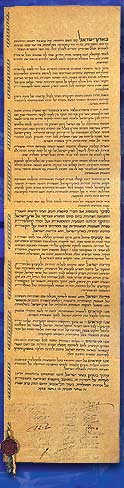
Scroll of tractate Hullin, Babylonian Talmud (CUL T–S MISC. 26.53.17), acknowledgment to Dr. S.C. Reif, Director of the Taylor-Schechter Genizah Research Unit at the Cambridge University Library, and the Syndics of the Library.

I was delighted in December, 2009 to hear Professor Shamma Friedman speak at a Talmud department seminar at JTS. He spoke about a controversial scholarly issue: whether Maimonides intended his Mishneh Torah to replace the Talmud.

This event reminded me of a Talmudic fact that Professor Friedman brought to light several years ago, i.e., that the Talmud was at an early time circulated in scroll form. He discussed this in his paper,  “An Ancient Scroll Fragment (Bavli Hullin 101a-105a) and the Rediscovery of the Babylonian Branch of Tannaitic Hebrew,” JQR 86:1 (1995), pp. 9–50.

3/22/17

Rav Soloveitchik, Rav Lichtenstein, Prof. Weidhorn, Prof. Flatto, Prof. Levy: My Five Greatest Teachers at Yeshiva University

I realized over the years since I graduated from Yeshiva College that so many of my teachers there imprinted upon me indelible lessons for life and learning. I have chosen here to recall five special teachers. I apologize to the many other wonderful teachers that I have omitted. I especially beg the forgiveness of those that I have chosen to so briefly and inadequately remember. Nothing that I say can do them justice.
[Periodic re-post -- to celebrate these great teachers.]

2/2/17

Shabbat Limo Riders and Shul Avoiders: My Dear Rabbi Zahavy Column in the Jewish Standard for February 2017

My Dear Rabbi Zahavy Column for February 2017: 
Shabbat Limo Riders and Day School Paying Shul Avoiders

Dear Rabbi Zahavy,

I was brought up Orthodox and continue to represent myself as such. I married a woman who converted to Orthodox Judaism to marry me. Recently, my influential father-in-law invited me to an important high-profile gala dinner on a Friday night. I did go to the dinner with my wife, and we returned home in a limousine after sunset.

Before doing this, I asked my rabbi, and he said that because of the circumstances I was permitted to attend and to ride home. Still, a lot of Orthodox people have criticized me for going to the event and for taking the ride.

I want to know — did I act properly?

Shabbat Limo Rider in Livingston

Dear Limo Rider,

Yes, you acted properly. You respected your father-in-law. You respected the importance of your situation. You respectfully asked your rabbi. By having someone drive, you did not violate the direct Sabbath restrictions against performing forbidden labors.

1/4/17

In a book honoring Jacob Neusner, read my essay, Varieties of Religious Visualizations

A Legacy of Learning: Essays in Honor of Jacob Neusner (Brill Reference Library of Judaism.) was published in 2014. My essay is in the book.

My contribution is Varieties of Religious Visualizations by Tzvee Zahavy:

In this paper, I describe several distinct visualizations that I recognize in Jewish prayers. By the term prayers, I mean the texts recited by Jews in religious ritual contexts. By the term visualizations, I mean the formation of mental visual images of a place and time, of a narrative activity or scene, or of an inner disposition. The goals of the visualizations can include: (1) professed communication with God, articulation of common religious values for (2) personal satisfaction or for (3) the sake of social solidarity, or (4) attainment of altered inner emotional states or moods.

You may download the paper at Academia or at Halakhah.com.

Or you can buy the book. It's pricy - I just sold my copy for a handsome ransom.


4/20/16

Rabbi Eleazar ben Azariah - a Star of the Seder

Passover is here once again. We will soon open our Haggadahs and find the familiar prologue stories to the Maggid section of the Seder. And soon we all will wonder, Who was Rabbi Eleazar ben Azariah?

Maggid is literally the "telling" of the story of the Exodus from Egypt, the event that we celebrate in our evening of dramatic activity. My teacher Rabbi Soloveitchik always underscored that this is not a mere retelling of a story. The Maggid is an archetypal session of rabbinic Torah study. The major section that we read is a classic rabbinic midrash that expounds upon a few condensed biblical verses. This is the exodus story as told by the rabbis, not by the Torah of Moses. To make the point unmistakably clear, the rabbis go so far as to omit the mention of Moses altogether in the Haggadah.

The rabbis do mention several of their own rabbis by name and top among them is my favorite, Eleazar ben Azariah. He was a second century rabbi in Israel who also held the highest political position in his community.