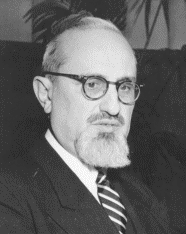
Showing posts with label yeshiva. Show all posts

9/28/22

Can a Jew Pray Directly to the Divine Attribute of Compassion?

Can a Jew pray directly to the Divine Attribute of Compassion? Yes, in just one prayer each year.


On Yom Kippur in Neilah, in the final series of the prayers of compassion that we call the selihot, we utter the catalogue of God’s thirteen mainly emotional attributes over and over again, the familiar:

“Lord, Lord, God, Compassionate, with loving kindness, patient, with kindness and truth; keeper of mercy for thousands, forgiver of iniquity, transgression and sin; clearing us. Forgive our iniquity and sin and accept us.” (cf. Exodus 34:6-7)


Within this sequence of repeated meditations, the tenth century Italian payetan Rabbi Amitai ben Shepatiah presents in his prayer a direct appeal to the divine attribute of compassion to intercede for us:
Attribute of compassion, pour upon us
In the presence of your creator, cast our supplications
For the sake of your people, request compassion
For every heart has pain and every mind is ill
(Goldschmidt, YK, p. 778)

5/27/22

My father's most valuable autographs - the signatures on his ordination parchment

I republished this post in honor of the Yeshiva University Chag HaSemikhah Convocation that took place on Sunday, March 19, 2017 and in honor of the 75th anniversary of my father receiving his ordination.

I received my rabbinic ordination from Yeshiva in 1973. My father received his semichah on March 19, 1942 = א׳ בְּנִיסָן תש״ב

Here is my original post:

In May 2012, during the shiva for my dad, Rabbi Dr. Zev Zahavy, I showed many people an important part of our inheritance from him - five valuable autographs.

Now these are not autographs of Babe Ruth or Mickey Mantle or of U.S. presidents or anything like that. 

These are the five signatures on my dad's klaf - on his diploma of ordination from Yeshiva University's Rabbi Isaac Elchanan Theological Seminary, which he received in 1942.

The priceless autographs are by five great Torah scholars, Rabbi Binyamin Aronowitz, Rabbi Bernard L. Levinthal of Philadelphia, Rabbi Samuel Belkin, Rabbi Moses Shatzkes (the Lomza Rav) and Rabbi Joseph B. Soloveitchik of Boston (the Rav).

Rabbi Yossi Adler looked at the klaf during the shiva in Teaneck and confirmed what I had been told, that it was rare to have five signatures on such a document. My own ordination has two (Rabbis Belkin and Soloveitchik).


I once asked my dad what it was like to go before these five great rabbis and be examined before receiving semichah - ordination. He told me, "They were tough. They asked difficult questions. They made me sweat."

I greatly treasure this meaningful part of the legacy of my dad.


4/12/21

Yahrzeit of Rav Aharon Lichtenstein, great Torah Sage and the Quintessential Scribe

My teacher and rebbe Rav Aharon Lichtenstein passed away six years ago.

He was awarded the Israel Prize 2014 in Jewish religious literature.

He was one of the finest teachers that I studied with in college - a genius as an educator and a sincere and compassionate human being. He is the person that I chose to personify the quintessential scribe personality of prayer in my book "God's Favorite Prayers (p. 71 ff)." Here is the excerpt.

The Scribe’s Prayers


I had the privilege of studying in Rav Aharon Lichtenstein’s Talmud shiur (class) for two years, 1966-1968. Each December, he invited us talmidim (disciples) to his house for latkes (potato pancakes) on Hanukkah. There, in his apartment, we sat with his little kids and his wife Tovah, daughter of Rav Joseph B. Soloveitchik. The latkes were good and the Lichtensteins appeared to be a regular family. For some reason, that surprised me.

Once, during the years that I was in his shiur, while I was out with some of the guys playing basketball on the courts between the Yeshiva College dorms, Rav Aharon, a lanky, thin and tall man, came walking by. One of us had the chutzpah to ask him to join the ball game. He said okay and he played aggressively—and just like a regular guy. For some reason, that blew my mind.

And, one year, in our student play, the Yeshiva College Purim shpiel, a satiric revue for the holiday, I played the role of Rav Aharon. In my performance, I hemmed and hawed and exaggerated my rebbe’s mannerisms much more than I should have. And there in the audience sat my rebbe, laughing heartily along with us. For some reason, that really blew my mind.

6/11/20

How to Deal With Facebook Stalkers, List Snubs and Technology Taboo Makers - My Jewish Standard Dear Rabbi Zahavy Column for June 2020


Dear Rabbi Zahavy,

I am on Facebook a lot and have many friends there. Recently, one of those people, whom I have known for many years, started replying negatively on every post that I made and on every comment that I put on Facebook. These were not just critical replies. They were snarky at first, and then became nasty and highly personal in nature.


I unfriended this person. But somehow, he still manages to find and comment on all my posts. What should I do to stop this?

Besieged in Bergenfield


Dear Besieged,

Facebook has mechanisms for actively blocking content from specific individuals. You can and should poke around the platform until you find them, and then invoke the harshest level of blocking against this offending person. Be persistent. Since Facebook thrives on content proliferation, your postings make money for them, and thus it deliberately makes the blocking process possible, but neither easy nor intuitive.

9/5/19

My Jewish Standard Dear Rabbi Zahavy column for September 2019 - Your talmudic advice column - What should I do about our tribal rituals and knowledge

My Jewish Standard Dear Rabbi Zahavy column for September 2019
Your Talmudic advice column
What should I do about our tribal rituals and knowledge

Dear Rabbi Zahavy,

I was shocked to read an op-ed in an Israeli newspaper by a writer who made radical assertions — seemingly without much evidence to support his assertions — that circumcision (bris milah) was not a central ritual of ancient Israel. The writer, moreover, proposed eliminating circumcision from Judaism, seemingly reflecting his blindness to his own Jewish culture and religion. Is eliminating circumcision now a trend among some secularist Jews? What can we do to stop this trend?

Bris Defender in Bergenfield


Dear Defender,

While many Jews assume that circumcision is a universal practice among their fellow Jews, that has not always been entirely true. In the early days of Reform Judaism in the 19th century, some classical Reform Jews openly opposed all rituals, including circumcision. And today, as you suspect, there are some young Jewish Israeli parents who refuse to circumcise their sons.

I have a devout Jewish friend who was terribly upset when her son in Israel did not circumcise her new grandson last year. I observe that it is trendy now in some progressive communities in Israel not to circumcise baby boys.

The article you cited provides some rationalizations for those people, but it is based on dubious historical claims.

6/5/19

Free download files of the Babylonian Talmud in English

I am proud to provide for you as a gift, a download of the complete Babylonian Talmud English translation.

The Talmud in English is online and free at my site, Halakhah.com, http://www.halakhah.com/ - serving up 60,000+ downloads each month.

TRANSLATED INTO ENGLISH WITH NOTES, GLOSSARY AND INDICES UNDER THE EDITORSHIP OF RABBI DR. I. EPSTEIN B.A., Ph.D., D. Lit. FOREWORD BY THE VERY REV. THE LATE CHIEF RABBI DR. J. H. HERTZ. INTRODUCTION BY THE EDITOR.

This set contains the Sedarim (orders, or major divisions) and tractates (books) of the Babylonian Talmud, as translated and organized for publication by the Soncino Press in 1935 - 1948.

My site has the entire Talmud edition in PDF format and  about 8050 pages in HTML format, comprising 1460 files — of the Talmud.

I recommend that on your web site or blog you add a link to this site http://www.halakhah.com.

Highlights include: A formatted 2-column PDF version of the Talmud at Halakhah.com.

    11/8/18

    Awesome 665 page translation of Hullin by Tzvee Zahavy - Great for Daf Yomi Study


    Incredible 665 page translation of Talmud Hullin!

    For Daf Yomi Hullin for your Kindle or Kindle App. Here is the Product Description:

    To know what food is kosher, that is, fit to eat according to rabbinic Judaism, you must study the principles set forth in this volume, the Babylonian Talmud Tractate Hullin.

    This translation, (approx. 665 pages) adheres closely to the text so that the reader has a sense of the structure and balance of the original. Yet at the same time it conveys the flow of the legal arguments and debates, the dramatic unfolding of events in stories, and the sensitivities to words and language in the exegetical texts.

    Its aim is to facilitate a smooth conversation between readers and the text so that, without consulting the original Hebrew and Aramaic version, they can appreciate the substantive meaning and recognize some major aspects of the style of the Talmudic text.


    3/8/18

    What made Rav Soloveitchik a simply great Talmud teacher

    It's now 25 years since my renowned teacher, Rav Soloveitchik, passed away.

    When I published this short essay in 2005 in the Commentator, the YU undergraduate newspaper, I was proud to extol my rebbe in the most glowing terms I could imagine. After further review, as they say in the NFL, I still feel that way. I republished this in honor of the Yeshiva University Chag HaSemikhah Convocation that took place on Sunday, March 19, 2017. I received my rabbinic ordination from Yeshiva in 1973. My father received his rabbinic ordination from Yeshiva March 19, 1942.

    Here again is my meager and utterly inadequate tribute to a truly great man.

    R. Joseph B. Soloveitchik: Indelible Beginner

    In the fall of 1969, as a college senior, I started four years of learning in Rabbi J. B. Soloveitchik's Talmud shiur.  In my family we venerated the Rav above all other rabbis. We spoke of him with the utmost reverence that one would bestow only upon a truly saintly man.

    I received in those four years so much from the Rav: a methodology of learning, a theology of Judaism and, above all, a secret of pedagogy.

    Let me explain briefly this last point. The Rav would sometimes in an occasional moment of surprising self-reflection refer to himself as a "poshutte melamed," just a teacher of beginners. That statement puzzled me. Surely the Rav was the greatest sage of our generation. How could he represent himself in this ordinary way?

    One day I accidentally discovered what he meant. We convened on the fourth floor classroom for our shiur - about to begin studying a famous sugya in Massechet Shabbat. That day I was using a Talmud volume from a small shas that my uncle had used when he studied in the Rav's shiur many years earlier, in the fifties. I found interleaved in this book a page of my uncle's notes (i.e., Rabbi Noah Goldstein, my dad's brother) from the Rav's discourse on this sugya fifteen or twenty years earlier.

    As we started reading the text, the Rav began to perform the magic that he was so good at. He made it seem to us all as if he was looking at the text for the very first time. He made every question he raised appear as if he was discovering a problem afresh. He made every answer and explanation that he examined in Rashi or the Tosafot appear to us as if it was new to him - a complete surprise.

    The Rav dramatically unfolded a complex and intricate exposition of the sugya - and each stage of the discourse seemed so new and alive. Yet as I followed along and I read in my uncle's notes, I saw that the Rav was repeating each and every element of the shiur exactly as he had given it years before, insight by insight, question by question and answer by answer. He had me convinced that he had just discovered every element of his learning. Yet I had proof in front of me to the contrary.

    I saw that day how the Rav had the ability to make every act of learning a new, exciting and living revelation. I have striven to emulate him ever since to replicate this ability and to achieve as a learner and as a teacher some small element of this revelation.

    Hanging over my desk as I write this I have a quotation from the great German Poet Rainer Maria Rilke, "If the angel deigns to come it will be because you have convinced her not by tears but by your humble resolve to be always beginning: to be a beginner."

    I believe the Rav would agree.

    //repost from 8/2009//
    5/29/17

    Can you be both Secular and a Zaddiq?

    You do not have to be a Hassidic Jew to be a Zaddiq.

    You do not have to be traditionally religious to be pious.

    Piety means that you live day-to-day and physically act with a connection to Judaism. It means that you maintain vivid moods and motivations in accord with a faith in the Torah.

    Piety means that you transform everyday activities, decisions, and attitudes. It means that you give them special significance. And where does that come from? It can come from the historical, mystical, and redemptive beliefs of Judaism. When you live with piety, you create and perform new practices based on your faith.
    • Your motives and goals as a pious person are to enhance every day of your life.
    • To bring you sanctification, qedushah.
    • To bring you more awe, love, or fear of God.
    • To allow you to submit to a higher power and create a sense of creatureliness.
    • To guarantee you an entry to paradise in the "World to Come" (for those who believe in the afterlife or heaven).
    • To bring for all in your world some form of redemption.
    • And, on a most basic level, you may believe that piety also brings you some material gain.
    We usually call piety mitzvah when it is an obligation and commandment within Judaism binding on an entire community of faith.

    We call piety custom or minhag when it is more limited in time and place and less authoritative. Most often this distinction goes unrecognized in your life as a pious Jew.

    The ultimate yardstick of piety is the Zaddiq -- the righteous saint. He or she adheres most closely to the norms of ultimate piety. The righteous saints are those who we would call purely ethical, those who flourish as proper humans, and those who achieve true virtue.

    Not many of us reach the ultimate in any part of our lives. We play golf, never expecting to become a Tiger Woods. We paint, do business, make love, for the fulfillment of each element of our lives. Yet we sometimes forsake religion because we think piety is out of our reach.

    Piety is there for all of us.

    3/22/17

    Rav Soloveitchik, Rav Lichtenstein, Prof. Weidhorn, Prof. Flatto, Prof. Levy: My Five Greatest Teachers at Yeshiva University

    I realized over the years since I graduated from Yeshiva College that so many of my teachers there imprinted upon me indelible lessons for life and learning. I have chosen here to recall five special teachers. I apologize to the many other wonderful teachers that I have omitted. I especially beg the forgiveness of those that I have chosen to so briefly and inadequately remember. Nothing that I say can do them justice.
    [Periodic re-post -- to celebrate these great teachers.]

    2/9/15

    A Reexamination of Rav Soloveitchik's Ban on Interfaith Dialog

    I recommend this insightful article from European Judaism, Volume 47, Number 2, Autumn 2014: 95–106: "SOLOVEITCHIK’S ‘NO’ TO INTERFAITH DIALOGUE," by Angela West.

    Abstract
    Rabbi Joseph B. Soloveitchik, one of the outstanding figures of modern Orthodox Judaism in the twentieth century, was opposed to interfaith dialogue and more particularly, to theological dialogue with the Catholic Church. In guidelines laid down in his paper ‘Confrontation’ in 1964 he proposed that Jews and Christians should discuss social and ethical problems together, but not matters theological. Since he was personally well acquainted with non-Jewish secular learning and had a philosophically sophisticated understanding of the role of halakhah, there has been much speculation as to why he sought to restrict dialogue in this way. Fifty years after ‘Confrontation’ was issued, it may be useful to re-examine his reasons and motivation in this matter and consider what relevance it has for contemporary interfaith relations.

    You can obtain a copy (PDF) and additional related material here: To Access the Special Virtual Issue from European Judaism, please visit: http://bit.ly/World-Interfaith-Harmony
    For more information about European Judaism, visit: www.journals.berghahnbooks.com/ej

    VOLUME 47, NUMBER 2
    Soloveitchik's 'No' to Interfaith Dialogue, Angela West
    VOLUME 46, NUMBER 1
    Reflections on the Promise and Limitations of Interfaith Dialogue, Paul R. Mendes-Flohr­
    Social Media and the Movement of Ideas, Edward Kessler
    Power and Authority in Religious Traditions in Islam: Reflections about issues of power and authority in the traditions and the present situation of Muslims in Europe, Hüseyin Inam
    Growing Up Religiously in a Changing World, Julia Gardos
    VOLUME 45, NUMBER 1
    The Integrity of John Rayner and Inter-faith Relations, Richard Harries
    Rabbi Hugo Gryn as Preacher, Marc Saperstein
    VOLUME 39, NUMBER 2
    Forty Years of European Judaism – Thirty Eight Years of Dialogue, Michael Hilton
    VOLUME 37, NUMBER 1
    Dialogue? Thank You, No! Ten Commandments for Interfaith Dialogue, Claus Leggewie

    Background on World Interfaith Harmony Week - Virtual Issue from Young Lee:


    The first week of February is World Interfaith Harmony Week, which aims to promote harmony between all people regardless of their religious faith. In honor of this event, we are delighted to offer free access to the following articles from our journal, European Judaism that deal with many aspects and opinions of interfaith dialogue and relations.

    1/25/15

    Is Sheldon Silver Jewish?

    Yes New York State Assembly Speaker Sheldon Silver is a Jew. He is a member of the Orthodox community on the Lower East Side of Manhattan, and a graduate of Yeshiva University, class of 1965.

    Sadly, he was arraigned at a federal courthouse Jan. 22, 2015, on bribery and corruption charges.

    JTA reported on the story and linked it to another scandal involving an associate of Silver.
    William Rapfogel, the longtime CEO of New York’s Metropolitan Council on Jewish Poverty, was arrested in September 2013 for involvement in a kickbacks scheme. He pleaded guilty to helping fleece more than $9 million from the charity, including $1 million that he pocketed himself, and was sentenced last July to 3 ½ years in prison and ordered to pay $3 million in restitution.

    Rapfogel’s wife, Judy Rapfogel, is Silver’s chief of staff. After her husband’s arrest, Judy Rapfogel claimed she had no knowledge of her husband’s criminal malfeasance, and she remained on Silver’s staff.

    Silver and William Rapfogel lived in the same neighborhood and went to the same shul, the Bialystoker Synagogue on Manhattan’s Lower East Side. The two men often sat together in the sanctuary on Shabbat morning, though in recent years Silver began going to the early minyan on Saturday mornings, a neighborhood insider who declined to be identified told JTA.

    11/2/14

    New York Post: Non-Jews enforce Segregation of Women by Attire at the Yeshiva of Flatbush

    The NY Post reports that the Yeshiva of Flatbush has hired non-Jews to enforce the segregation of women through attire regulations.

    Not surprising. Within synagogues in nearly all Orthodox Jewish communities women are segregated from men. They are instructed to sit behind a curtain or divider. In many arenas of Orthodox society women are told to dress modestly and cover up their arms and legs.

    To me it seems clear that a modesty dress code is another form of the segregation of women from the presence of men.

    It’s reasonable to say that these rules and the patrols to enforce them are about segregation based on gender, the denial of equal rights to women and discrimination against women.

    You may ask then, Aren’t all of those practices unacceptable in our modern Western societies?

    Yes sir. Yes ma’am. They are unacceptable. Segregation of any kind is evil. We need to desegregate our Yeshivas.

    The picture to the right above shows Alabama Governor George Wallace blocking the desegregation of the University of Alabama in 1963 - 51 years ago.
    Morality police patrol for exposed flesh at NYC school 
    ‘WE CAN’T JUST WALK IN THE HALLS BECAUSE EVERYONE’S LOOKING AT US AND JUDGING US EVERY SECOND FOR OUR CLOTHING. OBVIOUSLY, IT’S DEGRADING.’
    - senior Melissa Duchan

    By Andrea Hay

    Melissa Duchan says the dress code at Yeshiva of Flatbush is way over the top.

    The morality police aren’t just patrolling Iran or the Islamic State — they’re standing watch at a school in Brooklyn.

    Female students at ­Yeshiva of Flatbush are outraged that two monitors were hired this school year to patrol hallways for exposed collarbones and calves.

    The modesty crackdown comes as the school enforces a new, stricter dress code, including longer skirts.

    “We’re walking in and we’re being scrutinized every morning,” said 16-year-old senior Melissa Duchan. “We can’t just walk in the halls because everyone’s looking at us and judging us every second for our clothing. Obviously, it’s degrading.”

    8/27/14

    My Rebbe, Rabbi Gerson Yankelewitz has died at 104

    My Talmud teacher in high school, my rebbe for two years, passed away a few days ago at age 104. Rabbi Yankelewitz taught his talmud shiur in Yiddish, a language that I did not speak. Yet I somehow thoroughly understood Rabbi Yankelewitz's shiurim. He made the texts so clear and was so patient, that I learned a tremendous amount while studying with him. After his shiur I went on the study with Rav Aharon Lichtenstein for two years, and then with Rav J. B. Soloveitchik for four years, and I became an ordained rabbi.

    I admired Rabbi Yankelewitz for being brilliantly learned and yet never boastful. And my highest compliment, I liked him as a person. He was at once a gentle man and a gentleman and a firm and persistent teacher.

    Reading this meaningful obituary below, I found myself near tears. It briefly describes a truly beautiful soul who has departed from our world. I am sure the soul of Rabbi Yankelewitz will cheer and brighten the next world, where I pray that he has everlasting peace in the paradise of Gan Eden with all of the eternal rewards that he so richly earned and deserves.
    Long-serving YU Prof Succumbs At 104. Rabbi Gerson Yankelewitz remembered as ‘true giant’; studied with fabled leaders of old world Jewry.
    Steve Lipman

    ...Rabbi Gershon Yankelewitz, died at 104 on Aug. 19 of a heart attack he suffered during the morning Shacharit service in upstate New York, where he spent his summers for several years. He was buried in Israel.

    Rabbi Yankelewitz, who lived in the Pelham Parkway neighborhood of the Bronx, was believed to be the oldest person who maintained a regular teaching schedule at any university, yeshiva or rabbinical school in the United States, according to a YU spokesman. With the title senior rosh yeshiva, he taught a daily Talmud class and conducted a weekly Mussar (ethics) lecture for 60 years, and gave a daily lecture on Mishnayot between Mincha and Maariv services at the Young Israel of Pelham Parkway.

    8/21/14

    New in an Amazon Kindle Edition - Harry Fischel: Pioneer of Jewish Philanthropy

    A Fine Blend of Scholarly and Popular Jewish Books

    From Kodesh Press

    Harry Fischel: Pioneer of Jewish Philanthropy

    Harry Fischel was a household name in Jewish communities throughout the world during the first half of the previous century, but his impact on Jewish life today is even greater than it was when his biography was first published in 1928. What set him apart from virtually all the other philanthropists of his era was the percentage of his time and the amount of his fortune that he devoted to Jewish education in America and in Israel, and his roles in both founding and funding many charitable and educational institutions that changed the face of Jewish life for the better.

    Now Available on Kindle.

    (Also available in Hardcover and Paperback.)


    5/3/14

    My Favorite Talmud Teacher Rabbi Aharon Lichtenstein wins the Israel Prize for a Lifetime of Teaching

    The Israel Prize is awarded on Yom Haatzmaut. There is a great profile by Professor Alan Jotkowitz of my favorite Talmud teacher: Rabbi Aharon Lichtenstein, "Talmud scholar Rabbi Aharon Lichtenstein wins Israel Prize: Lichtenstein's work reflects an exceptional combination of knowledge of all aspects of the Torah and a depth of theoretical Talmudic thinking, incorporating original and creative thought, says award committee."

    Jotkowitz quotes Rav Lichtenstein regarding the value of humanistic learning, "Above all, culture instills in us a sense of the moral, psychological and metaphysical complexity of human life."

    Jotkowitz sums up Rav Lichtenstein's greatness and the premises on which it is built, "In addition to an obvious mastery of the sources, both Jewish and secular, relevant to the topic at hand, what distinguishes these essays is their ability to grasp the complexity of the issue and present both sides of an argument. This skill is sorely missing in the highly politicized and polarized modern Israel society. This skill was ingrained into Lichtenstein by the Brisker method, which highly values the ability to conceptualize and rigorously analyze two sides of an issue, and recognizes that two disparate values can coexist simultaneously."

    My view is that it's not the Brisker Method that produced Rav Aharon. His pure and penetrating Talmudic analytical intellect cannot be reduced to any single methodology. He transcends categorization and labelling. I am grateful that I had the honor of studying in his shiur for two of my most formative years when I was a student at Yeshiva College.

    2/27/14

    After Rattling Rabbinic Sabres Y.U. Backs Down and Will Ordain Rabbinical Student Who Held Partnership Minyan Service

    I am mentioned in the Forward article and I am glad this episode is winding down. Too much posturing and anonymity in this struggle.

    A longer interview with me got pared down to two paragraphs:
    Tzvee Zahavy, a former University of Minnesota professor who received ordination from Y.U. in 1973, also took issue with Penner’s letter. “There’s no asterisk on my semikha certificate saying, you have the authority, but you have to check with us first,” he said.

    Zahavy was so taken aback by the letter that he sent an email to Penner, asking whether Y.U. would like to revoke his ordination, since he supports the rabbinical student who held a partnership minyan. Penner wrote back, saying, “No, I doubt that’s necessary.”

    Yeshiva University Dean of Rabbis Denies News Account & He Won't Take My Semicha Back

    When I got my semicha (1973) I was proud that it said "Yoreh Yoreh Beissur Veheter" giving me my own franchise to issue religious decisions regarding what is forbidden and what is permitted in accord with the Torah, Talmud, commentaries, codes and responsa.

    Now my school YU has been saying of late through its great gadol and potent posek that in some public policy matters involving our religion, local rabbis can't do that unless they adhere to the halakhah and the mesorah as defined in Washington Heights. Well "the" halakah does not exist and "the mesorah" is a vague account of the transmission of religious authority. My franchise was never conditioned on those settings.

    I've been making religious decisions regarding what is forbidden and what is permitted for people in my community and family since 1973. But since the rabbi rules seemed to have changed, I made an offer to my school. It's brief and it's copied below, emails between me and Marc Penner.
    Would you like me to mail my semicha back to you?

    [Link to my post]

    Tzvee Zahavy
    RIETS 73
    No, I doubt that's necessary. We do not take back semikha and are not about to start doing so.
    In an attempt to protect the dignity and confidentiality of the student, the yeshiva has kept quiet about the issues in this case. The actions of the yeshiva were not, as you present them, a punitive measure relating to a minyan that he held in his home.

    Kol tuv
    Rabbi Marc Penner
    646-660-5858
    Sent from my iPad (please excuse any mistakes)
    Thanks for your reply. I am surprised to hear [back] from you.

    I do not write news or research stories. I only comment and offer opinion after others have already published materials. In this case I relied on the account by Gary [Rosenblatt] in the Jewish Week and on the TJC story as I cited. You may want to straighten Gary out - on or off the record.

    And no. I don't buy it. If you wanted to protect the dignity of the student you would not have written him that letter. I have no way of knowing what you are punishing a student for doing - but that letter was not the way to issue a reprimand. I'd hurry and retract it all if I were you [by saying e.g.,] "Yeshiva does not demand loyalty oaths or fealty statements from their students. It is unfortunate that I was misinterpreted."

    Good luck.
    Tzvee