Rerun of my previous popular summer advice.
Dear Rabbi,
I’m a young modern Orthodox woman. I like to go to the beach in the summer. Recently some of my friends criticized me for wearing a bikini at the beach. They say their rabbis taught them that it is not in keeping with our religion to wear a bikini because it is clothing that is not modest. I see that the prevalent fashion for young and fit women at the beach or pool is mostly a bikini. What makes your fellow rabbis think that they have the authority to dictate to me and other women what fashions to follow on the beach —or off it?
Two Piece in Teaneck
Dear Two Piece,
I’m one rabbi who does not claim to have women’s fashion expertise. I am relieved that you ask me about rabbinic authority, rather than what is the right fashion for you.
I do know that in the world of fashion you hear often about trends, not standards. I recognize that there is a lot of variety in the choices that women have, on and off the beach.
One day this summer I had the occasion to walk the length of the boardwalk in a Long Island South Shore beach community and could not help but observe that bikinis are a quite common choice for women, young and middle aged, at the beach clubs along the way. And I did notice in the Target ad flyer in the Sunday newspaper that most of the women’s swim suits on sale are bikinis.
Before anyone criticizes me for gazing upon women, let me refer to a story about one of our greatest talmudic rabbis, Rabban Gamaliel. According to the Talmud, when he saw a beautiful woman, Gamaliel recited a blessing, Blessed be He who made beautiful creatures in this world.
I agree with Gamaliel. Beauty is something that God bestowed upon our world. When the appropriate fashion allows for us to admire beauty in a tactful and respectful way, we may do so, and perhaps we should thank God with a blessing.
Now you may wonder, why don’t other Orthodox rabbis agree with Rabban Gamaliel and with me? Why do many religious authorities who happily admit that they have no knowledge or understanding of fashion go ahead and teach and preach that it’s a religious obligation that women must cover up their arms and legs and midriffs?
I don’t know why other rabbis have taken upon themselves the authority to dictate fashion requirements to women. And I find it hard to approve of that.
It seems to me wrong for any man to require women to cover up. Even though there is a long-standing theme in Jewish customs for married women to cover their hair and there are other customs for all women to cover much of their skin, the requirement of long sleeves and long skirts using the category of “modesty” is at best capricious. In the preponderance of contexts it also is out of step with the normal and customary notions of fashion in our general communities.
And one more thing. It is not a stretch for some folk to criticize the cover-up rules in Orthodox circles as yet another means of segregating women and as a way of denying them the freedom to choose and the rights to decide their own fashion options.
The notion that covering up all of your skin on the hot summer beach or at the pool or in the marketplace around town is connected to virtue is patently unfounded. Hence the rules that mandate overdressing are arbitrary annoyances at best.
Yet I’ve been told that there is a new women’s clothing store on Cedar Lane in Teaneck that sells kosher swimsuits made of nylon and polyester, comprising pants under a skirt and elbow length sleeves. I would not be surprised if these bathing costumes have tags on them certifying rabbinical approval.
Truly, I have no idea where my colleagues got the notion that wearing a bikini at the beach is a bad thing. I can’t explain or justify this rabbinic attitude to you. My advice to you is to follow your own notions of comfort and the prevailing styles and fashions of your immediate community.
And if anyone criticizes you, you may answer with a confident and polite reply, Thank you for your opinion. I will wear whatever I deem appropriate.
Tzvee Zahavy earned his Ph.D. from Brown University and rabbinic ordination from Yeshiva University. He is the author of many books, including these Kindle Edition ebooks available at Amazon.com: “The Book of Jewish Prayers in English,” “Rashi: The Greatest Exegete,” “God’s Favorite Prayers” and “Dear Rabbi” — which includes his past columns from the Jewish Standard and other essays.
7/7/18
7/4/18
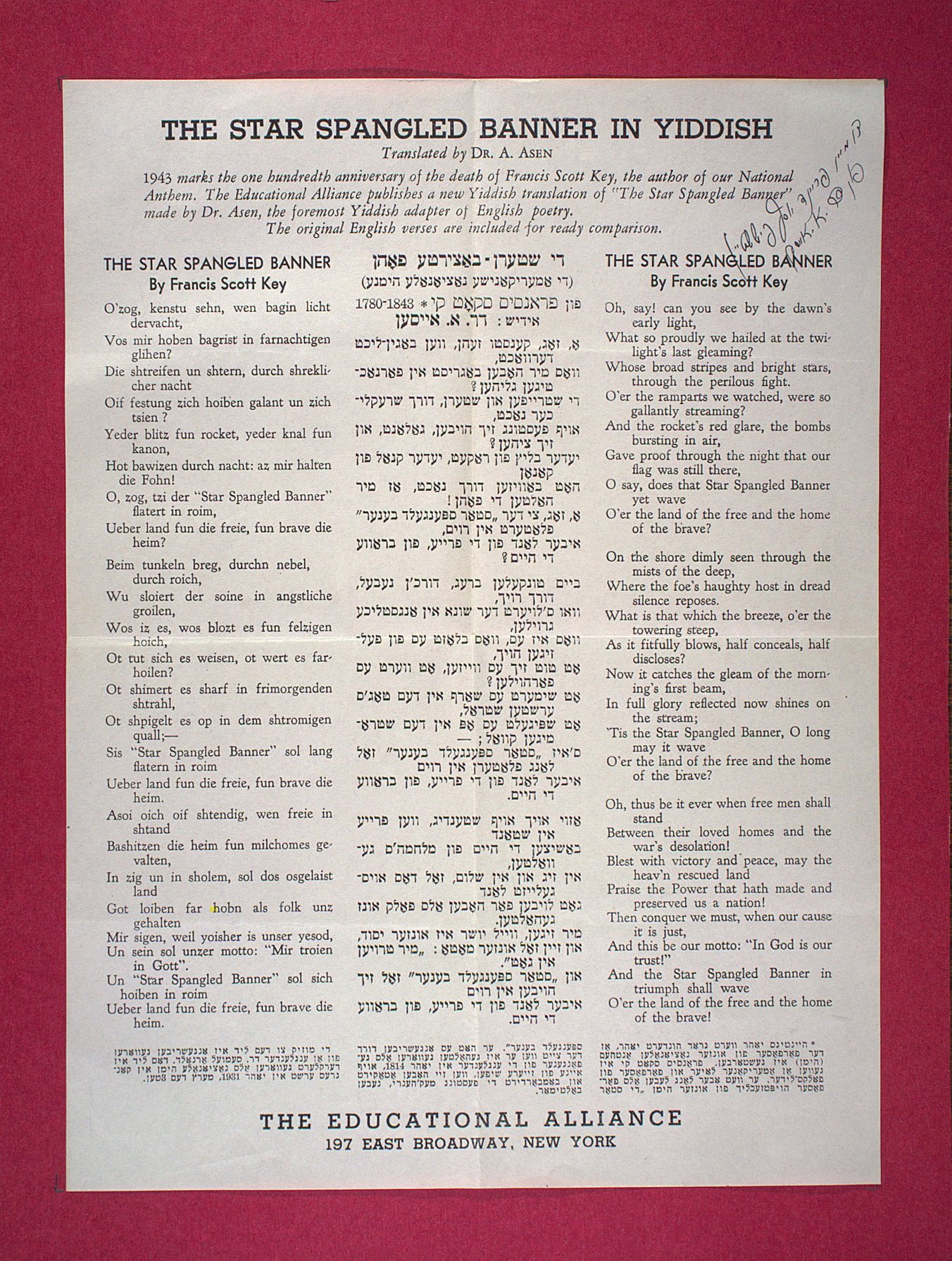
The Star Spangled Banner in Yiddish - Video
It's the 4th of July this week and time for us to sing again the Star Spangled Banner in Yiddish. This version's Yiddish translation by Berl Lapin.
Here is an earlier version courtesy of Jack Balkin. 1943 translation of the Star Spangled Banner into Yiddish by Dr. Abraham Asen, described as "the foremost Yiddish adapter of English poetry," and proudly presented in commemoration of the anniversary of the death of Francis Scott Key.
O'zog, kenstu sehn, wen bagin licht dervacht,
Vos mir hoben bagrist in farnachtigen glihen?
Die shtreifen un shtern, durch shreklicher nacht,
Oif festung zich hoiben galant un zich tsein?
Yeder blitz fun rocket, yeder knal fun kanon,
Hot bawizen durch nacht: az mir halten die Fohn!
O, zog, tzi der "Star Spangled Banner" flatert in roim,
Ueber land fun die freie, fun brave die heim!
I repost this every few years. Enjoy!
6/18/18
The Oxymoron of Modern Open Inclusive Orthodoxy: My Column for June 2016 for the Jewish Standard
Update: My column was the subject of discussion by Rabbi Steven Riskin and Rabbi Kenneth Brander at a Ohr Torah Stone forum at the Rinat Israel Synagogue on June 13, 2018, moderated by Jerry Silverman, President & CEO, Jewish Federations of North America.
See the video here.
My Column for June 2016 for the Jewish Standard
Dear Rabbi Zahavy,
In the past few years I’ve seen that people use the term “modern Orthodox” in news and opinion articles to describe a current form of Judaism. More recently, I read about a new group that sounds attractive to me, that wants to promote a more “inclusive” Orthodoxy. But I always have understood that Orthodox Judaism clearly says that it is the oldest and the original form of Judaism, that all of its practices are crucial to the survival of Judaism, and that they conform perfectly to God’s will as interpreted by the Orthodox rabbis. Why do people apply these fancy new labels for their faith? And is it hypocritical for me, if I embrace modern values, to continue to stay plain old Orthodox? Or should I join up with the new guys?
Confounded in Clifton
Dear Confounded,
If there was a supermarket where you could buy a religion in a box, you would not find many products with the label description “New and Improved.” But you would find most with the description, “Same Classic Ingredients for Centuries (or Millennia).”
So you are correct to be confused about the term “modern Orthodox.” Orthodox Jewish authorities’ main claim to legitimacy is that the content of their system is not modern. They insist that it is ancient, dating back thousands of years, to God’s covenants with our patriarchs, and to God’s revelation of the Torah on Mt. Sinai. And you legitimately can scratch your head in disbelief when someone comes up with an incongruous title that implies that a religion can be ancient and modern at the same time.
So, you may ask, what then is all this talk about “modern Orthodoxy”? On the surface, I might dismiss that new label, or the similar tags “open Orthodoxy,” and “pluralistic Orthodoxy,” as marketing names without any deep meaning. I might say that they are meant to make the brand of religion that its leaders are selling more attractive to consumers.
6/8/18
Was Charles Krauthammer Jewish?
In JPost interview Krauthammer reflected on his Talmudic upbringing. He described himself in the interview we cite here as not very religious:
As for my own practice, it's fairly minimal, but I go on the required days. I go to Yizkor, those kinds of things. I once described to a friend my Jewishness - I said, I'm a Jewish Shinto. I believe in ancestor worship. That's the heart of my Judaism.We disagreed with most of what neoconservative Charles Krauthammer said about foreign policy. But from the excellent interview he gave to the Jerusalem Post, "The unfashionable Charles Krauthammer," we learned that his eloquent argumentation skills derive in part from his Orthodox Talmudic education.
Can you talk a little bit about your own Jewish upbringing and sense of Jewishness, and how that influences you? ...He suffered a tragic swimming accident when in medical school which left him paralyzed.
I grew up in a Modern Orthodox home. I went to Jewish day school right through high school, so half of my day was spent speaking Hebrew from age six to 16. I studied thousands of hours of Talmud. My father thought I didn't get enough Talmud at school, so I took the extra Talmud class at school and he had a rabbi come to the house three nights a week. One of those nights was Saturday night, so in synagogue Saturday morning my brother and I would pray very hard for snow so he wouldn't be able to come on Saturday night and we could watch hockey night in Canada. That's where I learned about prayer...
He was the subject of a Fox News program and was on Jon Stewart's show to promote his book, Things That Matter: Three Decades of Passions, Pastimes and Politics
Here is the entire article. It is no longer available at jPost.
"The unfashionable Charles Krauthammer"
5/27/18
New Yorker: At His 80th Birthday Party Philip Roth talked of Death
Remnick explains that death was Roth's main topic in his birthday remarks. An odd choice for a birthday festival for most folks but not for Roth.
Now, we usually don't dwell on the subject of death in our thoughts. But today we conclude our recitation of Kaddish for our dad. And that put us face-to-face with the subject. As we said in another post, we feel that through the public synagogue Kaddish ritual we firmly rooted our dad's soul into the community of Jews that he so loved and served with such dedication. As the community of Israel lives and flourishes, so does the energy of our dad live on. One form of immortality.
Dad's body rests in a cemetery in Israel on Har Hamenuchot overlooking the hills of Jerusalem. His presence there roots his soul in the Zionist dimension of our collective reality as a people. As the State of Israel lives and flourishes, so does the vitality of our dad live on. Another form of immortality.
Roth eloquently writes of the stones in a cemetery in New Jersey and the memory of his family. Roth has certainly rooted his soul in a public vital body of writing that will live on for a long time. A Rothian form of immortality.
Here is Remnick's teasing conclusion to his essay:
...Roth is the author of thirty-one books. His favorite, he has said, the one in which he felt the most free as he wrote it, is “Sabbath’s Theater.” Laughing a little to himself, Roth said that the novel, which was published in 1995, could easily have been titled “Death and the Art of Dying.” Its epigraph is Prospero’s line in Act V, Scene 1 in “The Tempest”: “Every third thought shall be my grave.” And within is the line from Kafka: “The meaning of life is that it stops.”
“The book is death-haunted,” Roth said. Mickey Sabbath, the turbulent, profane, and libidinous hero, is a man who is beyond discretion and taste, whose outrageous adulterous behavior is, Roth said, “his response to a place where nothing keeps its promise and everything is perishable.” As a boy, Sabbath lost the person closest to him in the world—his older brother, Morty, whose plane was shot down, in 1944, over the Japanese-occupied Philippines.
With that introduction, Roth read pages three hundred and sixty-three to three hundred and seventy of “Sabbath’s Theater,” one of the most stunning passages in all his work. He was not about to let us forget what eighty means. In the novel, Sabbath has gone south (“Tunnel, turnpike, parkway—the shore!”) to visit the Jewish cemetery where his grandparents, parents, and brother are all buried. I will not ruin it for you. To get the feel of the night, you must read the passage in full—or, better, read the novel entire. And imagine that this passage—with its great elegy of gravestones, with its memories of life lived, of a life cut short, and all of it in particular—imagine that this is what Philip Roth chose, very deliberately, as his birthday message, his greeting, his farewell. These were not his last words—please, not that!—but they were what he chose. Death-haunted but assertive of life. The passage ends with his hero putting stones on the graves of the dead. Stones that honor the dead. Stones that are also meant to speak to the dead, to mark the presence of life, as well, if only for a while. The passage ends simply. It ends with the line, “Here I am.”
Philip Roth was Attacked and Excommunicated at Yeshiva University in 1962
Cited from my article, Judaisms and Memories: Systemic Representations of the Holocaust.
VI. The Holocaust in the Discourse of Popular American Jewish Culture
The role of the Holocaust in the civil discourse of American Jews comes more sharply into focus through critiques in contemporary imaginative fiction. It plays an important role in popular Judaic non-systemic (counterculture) folk representations. Consider the blunt example of the writings and experiences of Philip Roth. (Cf. Young, pp. 109-112, for further discussion of Roth.)
Roth in The Facts: A Novelist's Autobiography (New York, 1988, pp. 127-130) recounts an anecdote that he calls his "excommunication" at a Yeshiva University symposium on fiction he participated in New York in 1962. At this "trial" he tells us he was grilled mercilessly by a moderator and audience who began after him with the question: "Mr. Roth, would you write the same stories you've written if you were living in Nazi Germany?" As framed, the query was merely a cloak for a dagger aimed at the heart of Roth's literary expressions. The questioner transparently meant, "Are you not a self-hating Jew?" Roth was so shaken by the attack, he could not respond at the time. Instead, he says, he has given his answer many times over in the fiction he has published, in his discourse, since that incident.
Of course, Roth could have answered easily and obviously. He was a product of Jewish cultural processes over several generations in an American democracy. He wrote for an American non-racist audience. He was nurtured on the great achievements of English literature. Jews within German society had no such nurture and faced an openly hostile racist culture. Roth could only have written his oeuvre for us. We read him, understand him, despise him or laugh with him and respond to his characters and caricatures.
Through his fiction he challenges the basic discursive truths of Judaic life and, in my view, allows us to better judge their cultural value and purpose. Roth's recent parody of Holocaust memory within American Judaism and the Zionist setting was also one of his most radical. In The Counterlife he developed the following.
The book's protagonist Nathan Zuckerman finds himself on a jet flight from Israel sitting next to Jimmy Lustig, of the West Orange Lustigs. Jimmy is a psychotic reversioner returning from study in the Diaspora Yeshiva. He plans to hijack the plane to Germany and issue a press release aimed at "regeneration for the Jews," (Philip Roth, The Counterlife, New York, 1988, pp. 188-9)
FORGET REMEMBERING
I demand of the Israeli Government the immediate closing and dismantling of Yad Vashem, Jerusalem's Museum and Remembrance Hall of the Holocaust. I demand this in the name of the Jewish future. THE JEWISH FUTURE IS NOW. We must put persecution behind us forever. Never must we utter the name "Nazi" again, but instead strike it from our memory forever. No longer are we a people with an agonizing wound and a hideous scar. We have wandered nearly forty years in the wilderness of our great grief. Now is the time to stop paying tribute to that monster's memory with our Halls of Remembrance! Henceforth and forever his name shall cease to be associated with the unscarred and unscarable Land of Israel!
ISRAEL NEEDS NO HITLERS FOR THE RIGHT TO
BE ISRAEL!
JEWS NEED NO NAZIS TO BE THE REMARKABLE
JEWISH PEOPLE!
ZIONISM WITHOUT AUSCHWITZ!
JUDAISM WITHOUT VICTIMS!
THE PAST IS PAST! WE LIVE!
In the novel, but a few pages later, Jimmy backs off. The press-release was just an irrepressible, offensive Jewish joke. As Jimmy says, "Come on, you think I'd be crazy enough to f--k around with the Holocaust? I was just curious, that was all. See what you'd do. How it developed. You know. The novelist in me." (Ibid., p. 193)
Roth's artifice is an inversion of remembrance. He casts the scene in terms of the most visible contemporary context of political violence - airline hijacking. Roth pits recent reversionary forms of Judaism against accepted American communal forms, and against State-sponsored monumental discourse. These fictive memories have undoubtedly been shaped and cultivated under the repression of the corporate personality of the system of civic American Judaism. Roth's characters express as their response a fierce struggle over the acceptance or rejection of the central belief system.
Cited from my, Judaisms and Memories: Systemic Representations of the Holocaust -- keynote address, Conference on the Effects of the Holocaust on the Humanities, University of Minnesota, March, 1989.
- repost from 4/25/06
5/4/18
My Jewish Standard Talmudic Advice Column for May 2018: Is Lazy Jewish? Is Showrooming Kosher? Is Facebook Treif?
My Jewish Standard Talmudic Advice Column for May 2018
Is Lazy Jewish? Is Showrooming Kosher? Is Facebook Treif?
Dear Rabbi Zahavy,
There are times that I feel like just doing nothing, taking it easy, and drinking in the moments of my life. For some reason, at those times I feel guilty about this interlude. I feel like I should be doing productive activities every day. But I want to enjoy this slow time. What can I do to ameliorate my sense of failure during my intervals of inactivity?
Lazy in Leonia
Dear Lazy,
Wow. This is a timely question at any season, but especially now as our kids get out of school for the summer. What will they do all day? Parents will scramble around to find ways to program every minute of the summer days for their kids.
It’s also a timely concern because so many of us are reaching the age of retirement. And our retirees are asking themselves how they will fill every day with pursuits and activities.
Pop culture has no fundamental problem with your question. Singer Bruno Mars’ hit, “The Lazy Song,” says it well. “Today I don’t feel like doing anything / I just wanna lay in my bed / Don’t feel like picking up my phone / So leave a message at the tone / Nothing at all…”
But the values of our Jewish teachings don’t buy that attitude at all. Going way back to the biblical book of Proverbs, King Solomon inveighs against the slothful person, “Go to the ant, you sluggard; consider her ways, and be wise… How long will you sleep, O sluggard? when will you arise out of your sleep?”
4/12/18
Mixed Up in Mea Sharim Wants to Join the IDF - Dear Rabbi Zahavy - My Jewish Standard Talmudic Advice Column - April 2018
Dear Rabbi Zahavy - Your Talmudic Advice Column
Dear Rabbi Zahavy,
I live in Israel and I learn Talmud at a black-hat yeshiva. I really want to go into the army, to serve in the IDF, because it is a universal requirement of the state and it provides a vibrant force to defend Jews against the array of Israel’s hostile enemies. Also, I have always felt that I was born to be a soldier.
My rebbe teaches us that full-time Torah study is the best way to protect and preserve the Jewish people. And he also calls the IDF the shmad apostasy army. He forbids his students from joining. I won’t go unless I have approval to do so from my religious mentor.
What should I tell my rebbe to convince him to permit me to serve?
Mixed Up in Mea Shearim, Israel
Dear Mixed Up,
Your predicament is a tough one. I can see how this dilemma can tear at your soul. On the one hand, you live in the heart of a community that teaches that the values of the Torah are sacred. You study in a yeshiva that is based on the premise that the mitzvah of talmud Torah — study of the sacred books — is paramount. One known metaphor that motivates you is this: If all the commandments and activities are placed on one side of a scale, and the commandment to study Torah on the other side, Torah study outweighs them all. Your community believes strongly in that value.
And there are teachers in your community who embellish the value of keeping mitzvot and studying the sacred books with mystical claims. Some do say that God protects the Jewish people because of the virtue of the tzadikim — the saintly people who study the Torah and fulfill the 613 commandments.
Your charedi community insulates you tightly from the general culture of the state. You live in a carefully crafted bubble that fences you off from all other surrounding communities, cultures, and worlds.
I get it. I grew up in an Orthodox family and attended Yeshiva University from high school through rabbinical school — for 11 years. Okay, that environment is more porous. It is open to the study of general disciplines of knowledge. Still many of the rabbis who taught me strongly believed in insulating, segregating, and separating the sacred from the profane. Torah study was special and sacred. And secular subjects were to be tolerated, not venerated.
4/7/18
USATODAY: Still men only at Augusta National the Master's Golf Course?
The Masters is the annual reminder to us all of how the old boys love their men only country clubs as USA Today asked in 2012, "Will Augusta National have its first female member?"
The story speculated on whether the club already had its first female member.
Three of the members of this most exclusive club in U.S. sports, if not in all of American culture, have traditionally been the CEOs of Exxon, AT&T and IBM. They have been invited to be members of Augusta National because they run the three corporations that sponsor the Masters. They've also been invited because they are men.As a famous Orthodox rabbi once told me, "When the women write the checks, then they will get called to the Torah." IBM writes a big check to Augusta National. A woman can join the club.
Last fall, however, IBM made a historic decision. It announced that as of Jan. 1, Virginia "Ginni" Rometty would become its first female CEO. Then, this week, on the eve of Masters week, Bloomberg News Service became the first to ask the logical question: Will Rometty become the first woman to wear a green jacket?
It's possible that the question actually might be moot. It is within the realm of possibility, remote as it might seem, that she's already a member and we simply don't know it yet.
Yet let us not rejoice that egalitarianism reigns at Augusta. As they say in French, "Un oiseau ne fait pas le printemps."
3/30/18
The Most Expensive Haggadah is the Sarajevo Haggadah
The answer is -- the rare illuminated Sarajevo Haggadah which also is said to be one of the most beautiful manuscripts and one of the most valuable books in existence.
My facsimile of The Sarajevo Haggadah that I bought a while back is awesome.
If you are at all interested in this Haggadah, you must read People of the Book by Geraldine Brooks.
Wikipedia explains:
The Sarajevo Haggadah is an illuminated manuscript that contains the traditional text of the Passover Haggadah which accompanies the Passover Seder. It is the oldest Sephardic Haggadah in the world, originating in Barcelona around 1350. The Haggadah is presently owned by the National Museum of Bosnia and Herzegovina in Sarajevo, where it is on permanent display.You can view quite a few pages from the Sarajevo Haggadah here.
The Sarajevo Haggadah is handwritten on bleached calfskin and illuminated in copper and gold. It opens with 34 pages of illustrations of key scenes in the Bible from creation through the death of Moses. Its pages are stained with wine, evidence that it was used at many Passover Seders. It is considered to be the most beautiful illuminated Jewish manuscript in existence and one of the most valuable books in the world. In 1991 it was appraised at US $700 million....more...
Or you can purchase a facsimile edition of your own here: The Sarajevo Haggadah
More posts about the Haggadah...
Subscribe to:
Posts (Atom)