10/5/19

Ten years later I still agree. Here is what is wrong with our Jewish prayer book commentaries

After reading in a June 2009 morning at KJ some initial and random comments in the new Koren-Sacks Siddur, I was reminded of what in the past I have found lacking in prayerbook commentaries.

They are not complicated enough.

They portray our services as if they are beautifully woven together and, in the case of the longer services, as if they unfold in a gentle rising crescendo of drama from initial inspiring prayers, through more meaningful and expressive liturgies to our culminating praises and petitions.

When you read our most popular prayer book commentaries, you think the correct background music for our prayers would be say something soothing and nearly seamless, like Beethoven's Moonlight Sonata.

I have logged many davening hours and I never saw the Orthodox Jewish services projecting this sort of connected and calm mood.

No I've always thought the services were at best symphonies with abruptly varying movements, often characterized by stark contrasts and even at times by cacophony.

Our Siddur is in fact a complex composite document that evolved over many centuries. Many hands had a role in expressing the values and beliefs that our collective prayers represent. By its own definition, such a work should not be a smooth fabric.

A few times I have attempted to say just this in the modes of expression that characterized our scholarly writings. For instance in a paper I wrote, "The Politics of Piety: Social Conflict and the Emergence of Rabbinic Liturgy," I summarized at the outset a major theme of our more lengthy arguments as follows,
Prayer services do not emerge spontaneously or arbitrarily in a vacuum. They are the public pronouncements of the central values and concepts of the religious leaders who initially propounded them and are social rituals that often emerge out of intense conflict and hard-fought compromise. Specific historical, social, and political conditions contributed to the distinct origin of two major rabbinic services. In the crucial transitional period after the destruction of the Temple, the Shema emerged as the primary ritual of the scribal profession and its proponents. The Tefillah at this formative time was a ritual sponsored mainly by the patriarchal families and their priestly adherents. Compromises between the factions of post-70 Judaism later led to the adoption of the two liturgies in tandem, as the core of public Jewish prayer. But this came about only after intense struggles among competing groups for social and political dominance over the Jewish community at large and concomitantly for the primacy of their respective liturgies. The political, social, and even economic dimensions of the religious life of the synagogues were crucial to the formation of nascent rabbinic Judaism.
I think this is what brings our Siddur alive. It's a story of sharply competing ideas and values all striving for attention within a closed but utterly vibrant religious world. That's the story I'd like to see in some variant form in our prayer book commentaries. It's the narrative of a dialectical theological universe of debate and dispute over which notion we ought to employ to express our most urgent needs before our creator. For instance, do we put our scribal needs at the top of our agenda? Or do we cast our priestly yearnings at the top of our list?

In our Siddur we see a constant flow of traffic, changing of lanes, jostling for position of values and notions, ideas and concepts. And more than this, we see layer upon layer of meaning imposed upon our every practice and festival. Sacred time in our prayer book has mystical, agricultural, historical and Torah-logical importance, all at once. And all of us see different angles of this "lasagna" of religious life.

(When I start using such metaphors, that means uh-oh, I must be getting hungry and it's time to wrap up the post.)

See these among my published writings for more details.

God's Favorite Final Yom Kippur Prayers and the Shofar Blowing that Ends the Fast

Here is what we say in the final pages of my recent book about God's Favorite Final Yom Kippur prayers and the Shofar blowing that ends the fast:

[At]…the final shofar blast at the close of the Yom Kippur fast, …the six disparate synagogue voices coalesce in brief shared characteristic prayers.

So let me recall for you one moment of recurring spiritual grandeur each year—the shofar blowing at the end of Yom Kippur in my unorthodox imagined synagogue.

I stand at the bimah with my friends. We are cleansed of our food and drink, and of our sins. After a day of prayer filled with compassion, we have let go of those negative habits, ideas and actions that separated us from one another. We see each other for who we are, separate personalities with diverse values and goals, united under a roof, in a community, sharing a past and future, and alive together in a productive, vibrant and respectful present. 

Here is my paper, "Yom Kippur: My Day of Compassion" - for your inspiration and enjoyment

Here is my paper, "Yom Kippur: My Day of Compassion" - with some 2017 review and comments.

Use this link if you do not want to go to Academia 

Is Bernie Sanders Jewish?

Yes, Bernie Sanders is a Jew, but the Times (2016) says that, "He Doesn't Like to Talk About It."

I was disappointed in Joseph Berger of the Times for interviewing his brother and not getting Bernie to talk about this.

And trust me, there are dozens of rabbis who would be happy to slam him in the Times for not being a good enough Jew.

The Times didn't give both sides very well and it skipped lightly over the surface of this complex issue

Here is the story:

When Senator Bernie Sanders thanked supporters for his landslide victory in the New Hampshire Democratic primary, he wistfully reminisced about his upbringing as “the son of a Polish immigrant who came to this country speaking no English and having no money.”

While the crowd cheered, Rabbi Michael Paley of New York was among many Jews watching the speech who were taken aback. He said he was surprised that the Vermont senator had not explicitly described his father as a “Polish Jewish immigrant,” a significant distinction given Poland’s checkered history with its Jewish population.

“Nobody in Poland would have considered Bernie a Pole,” Rabbi Paley said.

For 5780 Online Rosh Hashanah and Yom Kippur Kol Nidre services, on Video, on a Live Webcast

Our sincere and heartfelt best wishes to all our readers for a Year of Blessing and Health, Prosperity and Good Cheer.

Rosh Hashanah 5780 - 2019 falls on Monday, the 30th of September and continues for 2 days.

Yom Kippur 5780 - 2019 falls on Wednesday, the 9th of October.

From Central Synagogue in NYC come Rosh Hashanah and Yom Kippur online services and videos. Scroll down to find the feed and schedule. See the LIVE webcast of Kol Nidre services this year.

The 92nd Street Y also plans a webcast of services.

Rabbis on videos at various places discuss atonement and repentance. There also are holiday video recipes for tzimmes, honey cake and tagelach that you can find online.

And see Video-streamed Rosh Hashanah and Yom Kippur Services.

In these coming Days of Awe all of this is good nourishment for the soul.


Purchase some of these wonderful books for the holidays.


9/5/19

My Jewish Standard Dear Rabbi Zahavy column for September 2019 - Your talmudic advice column - What should I do about our tribal rituals and knowledge

My Jewish Standard Dear Rabbi Zahavy column for September 2019
Your Talmudic advice column
What should I do about our tribal rituals and knowledge

Dear Rabbi Zahavy,

I was shocked to read an op-ed in an Israeli newspaper by a writer who made radical assertions — seemingly without much evidence to support his assertions — that circumcision (bris milah) was not a central ritual of ancient Israel. The writer, moreover, proposed eliminating circumcision from Judaism, seemingly reflecting his blindness to his own Jewish culture and religion. Is eliminating circumcision now a trend among some secularist Jews? What can we do to stop this trend?

Bris Defender in Bergenfield


Dear Defender,

While many Jews assume that circumcision is a universal practice among their fellow Jews, that has not always been entirely true. In the early days of Reform Judaism in the 19th century, some classical Reform Jews openly opposed all rituals, including circumcision. And today, as you suspect, there are some young Jewish Israeli parents who refuse to circumcise their sons.

I have a devout Jewish friend who was terribly upset when her son in Israel did not circumcise her new grandson last year. I observe that it is trendy now in some progressive communities in Israel not to circumcise baby boys.

The article you cited provides some rationalizations for those people, but it is based on dubious historical claims.

8/10/19

My Jewish Standard - Dear Rabbi Zahavy - Talmudic Advice Column for July 2018 - Let's Fix The Ninth of Av

My Jewish Standard - Dear Rabbi Zahavy - Talmudic Advice Column for July 2018 - Let's Fix The Ninth of Av

Dear Rabbi Zahavy,

Our U.S. government recognized Jerusalem as capital of Israel on May 14, 2018, and dedicated its embassy there, moving it from Tel Aviv. I don’t understand how we can continue to commemorate the 9th day of Av as a sad fast day that memorializes Jerusalem as a destroyed desolate city, when the facts of today totally contradict that. Doesn’t the reality of today’s circumstances make it time to abolish the fasting and mourning of that day?

Puzzled in Paramus

Dear Puzzled,

We need to ask in general — why should we cede to religion the ability to legislate our emotions? What is the benefit of making people sad and mournful through rituals? Religion can do this, to a degree. By requiring fasting, by forbidding weddings from taking place, banning music for three weeks, by prohibiting haircuts and shaving, religion can try to manipulate moods and motivations. But why?

7/11/19

Finding Your Existentialist Judaism - Your Jewish Standard Talmudic Advice Dear Rabbi Zahavy Column for July 2019

Your Jewish Standard Talmudic Advice Dear Rabbi Zahavy Column for July 2019

Dear Rabbi Zahavy,

These days I am increasingly unsure of the nature of my Judaism — my religious identity. I know for sure that I am a Jew. Both my parents were Jewish. And I do observe the Jewish festivals and Sabbaths, but now not so rigorously or in accord with any single denomination. I find it more and more difficult to define my affiliation with any specific organized Jewish group. Some of my friends politely tell me that I need to decide where I stand and conform to the beliefs and standards of one of the forms of Judaism. I just don’t know that I can do that anymore. I do want to explore Judaism philosophically, but I don’t know where to start. What is your advice?

Drifting in Demarest


Dear Drifting,

Most folks cannot tolerate too much ambiguity. They look for certainty. It sounds like you are living with uncertainty in your identification with Judaism. And while in our society it is rare for people to overtly butt into other people’s lives and life choices, some of your friends must sense your unease. That’s why they are chiming in that you need to decide.

It is reasonable for people to want to know where their friends and relatives stand regarding Judaism. And they want a label to name your choice and to make the identification clear: Orthodox, Conservative, Reform, Reconstructionist, chasidic, Lubavitch; and in Israel there are category labels like dati, chiloni, Dati Leumi, charedi.

6/5/19

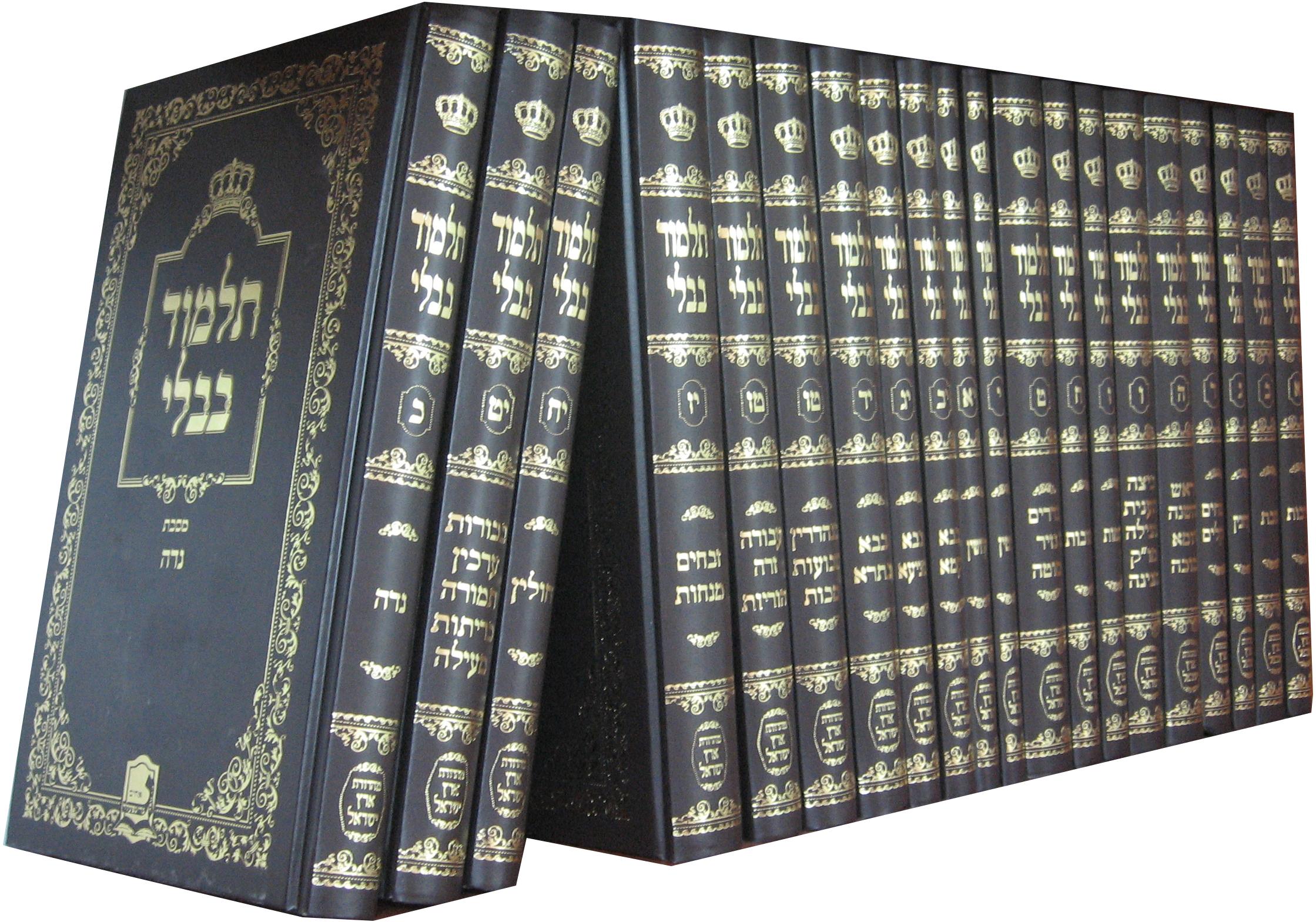
Free download files of the Babylonian Talmud in English

I am proud to provide for you as a gift, a download of the complete Babylonian Talmud English translation.

The Talmud in English is online and free at my site, Halakhah.com, http://www.halakhah.com/ - serving up 60,000+ downloads each month.

TRANSLATED INTO ENGLISH WITH NOTES, GLOSSARY AND INDICES UNDER THE EDITORSHIP OF RABBI DR. I. EPSTEIN B.A., Ph.D., D. Lit. FOREWORD BY THE VERY REV. THE LATE CHIEF RABBI DR. J. H. HERTZ. INTRODUCTION BY THE EDITOR.

This set contains the Sedarim (orders, or major divisions) and tractates (books) of the Babylonian Talmud, as translated and organized for publication by the Soncino Press in 1935 - 1948.

My site has the entire Talmud edition in PDF format and  about 8050 pages in HTML format, comprising 1460 files — of the Talmud.

I recommend that on your web site or blog you add a link to this site http://www.halakhah.com.

Highlights include: A formatted 2-column PDF version of the Talmud at Halakhah.com.