10/11/18

Who am I? My Jewish Standard Dear Rabbi Zahavy Talmudic Advice Column for October 2018

Jewish Standard 
Dear Rabbi Zahavy 
Talmudic Advice Column
October 2018

Dear Rabbi Zahavy,

I read a report in the news that psychologists have identified four major human personality types. Do you advise that I try to find out what is my type? What would the benefits be?

Typified in Tenafly


Dear Typified,

Indeed, this is a timely hot question for many reasons. In the September 10, 2018 issue of the New Yorker there’s an article, “What Personality Tests Really Deliver: They’re a two-billion-dollar industry. But are assessments like the Myers-Briggs more self-help than science?”

Its author, Louis Menand, discusses the famous and popular Myers-Briggs Type Indicator (MBTI), which helps people identify which of 16 personality types they are. The MBTI, it turns out, is controversial in terms of reliability and validity, but it is immensely popular in business settings and in personal growth efforts.

The newer study that you refer to was published recently and shows statistical evidence for the existence of four high-level personality types that the researchers call average, reserved, self-centered, and role model. These groupings depend on how much people display of five traits, specifically neuroticism, extroversion, openness, agreeableness, and conscientiousness.

I have reservations about getting all gung-ho about this study, even though it is based on a lot of real data, namely 1.5 million responses to four different personality surveys from respondents of all ages worldwide, analyzed by algorithms to sort the data into distinct clusters.

My hesitation is that the types in this study seem too general and almost common-sensical. That makes me wonder what the value of these distinctions may be. I have similar reservations about the MBTI and other instruments for personality identification and classification.

But on the other hand, sure, for many reasons we all could benefit from knowing more about ourselves. And if type-studies do assist us, then let’s embrace them for what they are — helpful augmentations to our intuitive insights into personalities.

Overall, I can think of several main reasons for seeking more clarity about human personality types, and identifying your own, to see where you fit in.

First, and what I believe is your motive for asking, knowing what is your type can increase your own self-awareness. The more you understand about yourself, the more mature you can be in approaching your life-decisions, such as what career to choose, what kinds of friends or spouse to seek, and many other basic issues that we all confront. That is a practical application that can be beneficial to you as an individual.

Typology-making also can be helpful in performing broader cultural analysis. The influential psychologist Carl Jung advanced the notion of personality archetypes in his 20th century writings. His followers, including Myers and Briggs, sought to apply his ideas to various aspects of cultures and societies, some more serious and scholarly, and others more popular.

A wonderful memorable illustration of the latter is the book “Goddesses in Every Woman: Powerful Archetypes in Women’s Lives” by Jean Bolen. Though her work refers to classical mythical goddesses, her purpose was to help people attain a secular understanding of their own personality types and those of others they may know.

For Bolen, a woman may be able to see herself through the prism of the goddesses of the Greek pantheon and thereby more clearly find her inner personality archetypes.

Typology-making also has been used to do constructive religious theology, the goal of which is not necessarily to gain personal insights, but rather to explain and promote the advantages and explicate the meanings of a particular religious system.

I was exposed to a topological brand of theology through the teachings of my rebbe, Rabbi Joseph B. Soloveitchik, who wrote about a type that he invented and called “Halakhic Man” in a famous long essay with the same title.

In that exercise, Soloveitchik constructed an ideal religious Jew (“Halakhic Man”) and contrasted that with two other human types that he called Cognitive Man and Religious Man. Cognitive Man, he says, represents an abstraction of a scientist, like a theoretical physicist or mathematician, who comes to know the world by constructing intellectual models and analyzing the actual world in systemic ways.

Religious Man, as Soloveitchik sees it, seeks to master the capacity for spiritual experience, to transcend physical reality and experience God’s immanent presence in the world.

Soloveitchik surprisingly relates the Halakhic Man type to Cognitive Man. Both approach the world with their respective intellectual models. Halachic Man comes to the world armed with the two Torahs, written and oral, revealed by God at Mount Sinai. Cognitive Man may use a model based on his received mathematical or scientific criteria, and Halachic Man understands his world via classical Jewish legal categories.

I’ve done my own theological application of typologies, in a book that I published in 2011 called “God’s Favorite Prayers.” I displayed there my analysis of the classic Jewish prayers through the prism of six personality types of Jews at prayer that I developed.

I devised types that I labelled the scribe, the priest, the performer, the meditator, the mystic, and the celebrity monotheist, to help me characterize the contents of the individual prayers that make up the composite prayer book that Jews compiled over the centuries.

My thesis in my book in brief is that the Shema prayer represents the values and traits of a scribe. The Amidah embodies the values of a priest. The grace after meals is an expression of a meditator. The Kaddish is a supplication of a mystic. And the Alenu prayer is a declaration of a celebrity monotheist, a triumphalist.

While my goal was to explain and bring focus on the substance and character of each prayer, I do expect that by delineating individual character types, I help people gain insights into their own religious personalities as well. Still, I haven’t yet devised a questionnaire to determine which archetype of prayer a person most closely matches. Perhaps I should put that on my creative agenda.

To get back to your question, clearly you may want to know your type to obtain a deeper personal self-understanding, or you may seek a better sense of broader social and cultural insights. Keep in mind that others around you will want to know your personality type for decidedly practical, and perhaps for pecuniary purposes.

Officers in the armed forces will want to precisely as possible identify the personality of its recruits to put them in the best possible tactical roles. So too will business managers want to know a personality type to place an employee in the best suited position. The Myers-Briggs inventory is used widely in business contexts.

Dating services will want to clearly know the traits of its clients to perform the best possible matching with potential mates. And of course, a marketing entity will want to know as much as possible about its potential clienteles, to target its efforts and to maximize its sales. Personality typing can be a shortcut to that goal.

Personality information is valuable in many respects. Current reports in the news tell us of a café near Brown University that will serve its clients coffee for payments not in money, but in the credits of the personal data that they provide.

My answer to your inquiry is, then, yes. You will want at some point for your own benefit and perhaps to serve the purposes of others, to ascertain details of your own personality type. But there is no hurry to do this. This area of psychological and social analysis is changing rapidly. Artificial intelligence algorithms and machine learning models are being refined, developed, and introduced as we speak, and used in the areas of these inquiries.

I can foresee in the near future the emergence of advanced and more granular typologies that identify not four or 16 but hundreds or thousands of personality types by applying models and algorithms to massive amounts of data.

And yet even given the state of the field, I could point out to you that there are plenty of naysayers who question the validity of these kinds of studies, and others who oppose its invasiveness on ethical grounds. Humorously, I could say to you that there are two basic types of people in the world, those who believe that personality type studies are immensely useful, and those who do not like them at all. I am closer to the former type.

The recent study we alluded to has limitations, as does any similar past attempts at typology. Deciding on the boundaries of types is often arbitrary. And though major personality traits are fixed in an individual, age does play a factor, and people can change. Young people, for instance, tend to be self-centered. Older people often seek to be role models. And yes, people who self-report on tests or inventories may deliberately or inadvertently misrepresent their own traits and preferences.

And again, all those test outcome observations seem close to the common-sense insights that a sage cultural critic could advance without resorting to any sophisticated questionnaire or data mining.

In any case, the longer you wait to explore this area of research, the more sophisticated the results and insights will be. Do follow up if you are so inclined, but keep in mind all of the above caveats and limitations, and don’t be in any rush to become typified.

Tzvee Zahavy of Teaneck has been a professor of Talmud, Jewish law codes, Jewish liturgy, Jewish history, Near Eastern and Jewish studies, and religious studies at major U.S. research universities and seminaries. His book “God’s Favorite Prayers” is available on Amazon in paperback or Kindle format. He received his Ph.D. from Brown University and his rabbinic ordination from Yeshiva University. Go to www.tzvee.com for details.

10/5/18

Are you a hedgehog or a fox?

My teacher in college c. 1971 in a seminar at the Bernard Revel Graduate School mentioned a book by Isaiah Berlin with great enthusiasm. He then applied the concept of the two archetypes, hedgehog and fox, to describe the nature of the work of two medieval rabbis (I forget which ones, but I'll wager he said Rabbenu Tam was a hedgehog and maybe Rashi was a fox.)

So I went over to the library and read the book, as I often did when one of my teachers mentioned a volume with high praise.

The other day at the office I tried to explain the archetypes to a talented programmer, noting after summarizing Berlin's theory that said developer came across as a hedgehog. And right then I realized that apparently I had lapsed into speaking Aramaic - or that was the look I got from my colleague.

Wikipedia has a nice precis of the book (it's just an essay really of 90 or so pages which is here in a PDF)...
"The Hedgehog and the Fox" is the title of an essay by Isaiah Berlin, regarding the Russian author Leo Tolstoy's theory of history.

The title is a reference to a fragment attributed to the ancient Greek poet Archilochus: πόλλ' οἶδ ἀλώπηξ, ἀλλ' ἐχῖνος ἓν μέγα ("The fox knows many things, but the hedgehog knows one big thing"). In Erasmus Rotterdamus's Adagia from 1500, the expression is recorded as Multa novit vulpes, verum echinus unum magnum.)

Berlin expands upon this idea to divide writers and thinkers into two categories: hedgehogs, who view the world through the lens of a single defining idea (examples given include Dante, Plato, Lucretius, Pascal, Hegel, Dostoevsky, Nietzsche, Ibsen, and Proust) and foxes who draw on a wide variety of experiences and for whom the world cannot be boiled down to a single idea (examples given include Shakespeare, Herodotus, Aristotle, Montaigne, Erasmus, Molière, Goethe, Pushkin, Balzac, Joyce, Anderson).

Turning to Tolstoy, Berlin contends that at first glance, Tolstoy escapes definition into one of these two groups. He postulates, rather, that while Tolstoy's talents are those of a fox, his beliefs are that one ought to be a hedgehog, and thus Tolstoy's own voluminous assessments of his own work are misleading. Berlin goes on to use this idea of Tolstoy as a basis for an analysis of the theory of history that Tolstoy presents in his novel War and Peace.

The essay has been published separately and as part of the collection Russian Thinkers, edited by Henry Hardy and Aileen Kelly.

Some authors, for instance Michael Walzer, have used the same pattern of description on Berlin, as a person who knows many things, compared to the purported narrowness of many other contemporary political philosophers. Berlin's former student, Canadian philosopher Charles Taylor, has been dubbed a hedgehog by Berlin and readily admits to it in an interview after receiving the 2007 Templeton Prize.

Berlin expanded on this concept in the 1997 book The Proper Study of Mankind. Philip Tetlock, a political psychology professor in the Haas Business  school at UC, Berkeley, draws heavily on this distinction in his exploration of the accuracy of experts and forecasters in various fields (especially politics) in his 2005 book Expert Political Judgment: How Good Is It? How Can We Know?.
You can read the first ten pages or so at Questia or here. Or the whole essay here.

And now we must ask, Are you a hedgehog or a fox? Choose!
(reposted from 7/08)

9/7/18

My Dear Rabbi Zahavy Talmudic Advice Column for the Jewish Standard September 2018: How to Have Happy Ho Hum Holidays and Who Pays When My Car Gores Your Car

Dear Rabbi Zahavy
Your talmudic advice column
September 2018
How to Have Happy Ho Hum Holidays and Who Pays When My Car Gores Your Car

Dear Rabbi Zahavy,

Despite what the rabbis say about the importance of the days, I’m not looking forward to the High Holy Days of Rosh Hashanah and Yom Kippur this year. In fact, I am at best indifferent to them. And specifically, thinking about all the hours I will have to sit in the synagogue makes me nervous. My synagogue’s seats are crammed together. I see many people there whom I do not know or like. I can hardly see the chazan and sometimes it’s hard to hear him. Also, I find the prayers confusing and hard to understand. Most of all I find my mind wandering away from the services, and I hardly pay attention at all, except to be sure to stand and sit at the right times. To tell you the truth I’m considering skipping the synagogue services altogether this year. Given all my issues with the praying, what do you suggest that I do?

No Patience for Prayer in Passaic

Dear No Patience,

It sounds clear to me that you are harboring a great deal of frustration with your holiday devotions. And it seems like you might be on the verge of needing to take a break from your synagogue, perhaps seeking out a new place of worship, or taking a vacation from some of the services.

8/14/18

The Classic Book Rabbi Joshua Trachtenberg's "Jewish Magic" - My wonderful edition for Kindle - Purchase Now

Please take extra special note and purchase my revised edition for Kindle of the great classic book Rabbi Joshua Trachtenberg's "Jewish Magic."


This book is a comprehensive review of Jewish magic from the 10th to the 15th century. This book explains well-known Jewish traditions, such as why a glass is broken at a wedding, and how the expression mazal tov is related to a belief in astrology. Rabbi Trachtenberg dealt with Golems, Succubi, the Lillim, (from Lilith, Adam’s first wife), and other magical creatures, some well-known such as werewolves, and others not so well, such as estrie, mare and broxa. He presented detailed descriptions of talismans, amulets, charms, and other magical objects. His chapters dealt with dream interpretation, medical beliefs, necromancy, and other forms of divination. Rabbi Trachtenberg’s appreciation of the role of magic in Jewish culture was significant for the study of Judaism, and for the knowledge of modern beliefs and practices in religions in general.

My New Title for the Book

The original title of this book in 1939 was Jewish Magic and Superstition. For this Kindle edition in 2016, I removed the tendentious terms superstition and superstitious from this otherwise excellent book and from its title, and I substituted where needed throughout the text of the book, either the words religious or magical to lend the discussion greater consistency and to remove the distracting and negative polemical aspect of those terms from this pivotal study.

Commonly the word superstition is used to refer to aspects of religion that are not practiced by the majority of a culture. It has had a pejorative connotation since the days of Plato and Aristotle. Wikipedia (s.v. Superstition) informs us that:
In the classical era, the existence of gods was actively debated both among philosophers and theologians, and opposition to superstition arose consequently. The poem De rerum natura, written by the Roman poet and philosopher Lucretius further developed the opposition to superstition.
Cicero’s work De natura deorum also had a great influence on the development of the modern concept of superstition as well as the word itself. Where Cicero distinguished superstitio and religio, Lucretius used only the term religio. Cicero, for whom superstitio meant “excessive fear of the gods” wrote that “superstitio, non religio, tollenda est,” which means that only superstition, and not religion, should be abolished… The term superstitio, or superstitio vana “vain superstition,” was applied in the first century to those religious cults in the Roman Empire which were officially outlawed.
 The Teaneck New Jersey Author

The author of this book, Rabbi Joshua Trachtenberg (b. 1904, d. 1959) was a reform rabbi at Temple Emeth in Teaneck, New Jersey. This book is an expansion of his Columbia University Ph.D. thesis.

Thanks go out to my valued collaborator, Reuven Brauner for his work improving the editing and formatting of this book for this Kindle eBook publication.


8/2/18

My Jewish Standard Dear Rabbi Zahavy Talmudic Advice Column for August 2018 - Should I Lie or Tell the Truth?

My Jewish Standard Dear Rabbi Zahavy Talmudic Advice Column for August 2018
Should I Lie or Tell the Truth?


Dear Rabbi Zahavy

I thoughtlessly violated a petty and unfair town ordinance. Now I am being fined for it. I’m thinking that I could just pay the fine, or I could go to the town and explain what happened and ask for a reduction in the fine. But nowadays it seems that our highest government officials have no hesitation making things up. Perhaps I can concoct a story to avoid the blame for my actions and avoid the fines. Would that be justified?

Conflicted in Cresskill


Dear Conflicted,

It should be easy for me to say that lying is not the preferred way to go. I’m obliged as a rabbi to represent ethical and moral standards. I should say without hesitation — tell the truth in good faith and ask your town to understand the situation.

But if we look around at all the obvious lying going on in our politics, in our world, it makes you stop and think. Maybe lying is a viable option. Maybe you will be better off if you lie.

And honestly, if you look closely at our Jewish traditions you see dramatic examples of lying recounted proudly in our Bible stories, without qualms. Why then should you opt for the truth?

Let’s critically probe three obvious instances of deceit by our esteemed and venerated patriarchs and ancestors as described in the first book of the Torah and see what we can learn from them.

7/24/18

Awesome Unlimited Mobile Plan from Sprint for $35 a month


For age 55+ (they don't check) you get 2 lines for $70 a month unlimited and a $50 Visa card for signing up.

Check for great deal on the Samsung Galaxy S9 - maybe 50% off.


7/18/18

Times: Bruce Lincoln et. al. say NIMBY to University of Chicago Center for Milton Friedman Economics

10 years ago 7/12/2008 - this is what was on my mind... a blast from the past.... It looks like the opposition of a decade ago failed to stop the project - see the link here to the Becker Friedman Institute about page and activities summary.

Repost from 2008 follows:

Apparently, my old colleague Bruce Lincoln is leading the opposition at the University of Chicago to a newly established Center for Milton Friedman Style Economics.

The Chi Trib quoted Lincoln last month, '"It is a right-wing think tank being put in place," said Bruce Lincoln, a professor of the history of religions and one of the faculty members who met with the administration Tuesday. "The long-term consequences will be very severe. This will be a flagship entity and it will attract a lot of money and a lot of attention, and I think work at the university and the university's reputation will take a serious rightward turn to the detriment of all."'

Now the Times
(in a notably weak and poorly researched article) has him saying less, that is, "As an opponent of the entire institute, rather than simply its name, Mr. Lincoln characterized himself on the extreme end of the opposition. He said he would like to see a research center “much more committed to free inquiry and a larger debate, and not just grinding the same ax sharper and sharper.”"

7/7/18

Bikinis and Rabbis: My Jewish Standard Dear Rabbi Column for August 2015

Rerun of my previous popular summer advice. 

Dear Rabbi,

I’m a young modern Orthodox woman. I like to go to the beach in the summer. Recently some of my friends criticized me for wearing a bikini at the beach. They say their rabbis taught them that it is not in keeping with our religion to wear a bikini because it is clothing that is not modest. I see that the prevalent fashion for young and fit women at the beach or pool is mostly a bikini. What makes your fellow rabbis think that they have the authority to dictate to me and other women what fashions to follow on the beach —or off it?

Two Piece in Teaneck


Dear Two Piece,

I’m one rabbi who does not claim to have women’s fashion expertise. I am relieved that you ask me about rabbinic authority, rather than what is the right fashion for you.

I do know that in the world of fashion you hear often about trends, not standards. I recognize that there is a lot of variety in the choices that women have, on and off the beach.

One day this summer I had the occasion to walk the length of the boardwalk in a Long Island South Shore beach community and could not help but observe that bikinis are a quite common choice for women, young and middle aged, at the beach clubs along the way. And I did notice in the Target ad flyer in the Sunday newspaper that most of the women’s swim suits on sale are bikinis.

Before anyone criticizes me for gazing upon women, let me refer to a story about one of our greatest talmudic rabbis, Rabban Gamaliel. According to the Talmud, when he saw a beautiful woman, Gamaliel recited a blessing, Blessed be He who made beautiful creatures in this world.

I agree with Gamaliel. Beauty is something that God bestowed upon our world. When the appropriate fashion allows for us to admire beauty in a tactful and respectful way, we may do so, and perhaps we should thank God with a blessing.

Now you may wonder, why don’t other Orthodox rabbis agree with Rabban Gamaliel and with me? Why do many religious authorities who happily admit that they have no knowledge or understanding of fashion go ahead and teach and preach that it’s a religious obligation that women must cover up their arms and legs and midriffs?

I don’t know why other rabbis have taken upon themselves the authority to dictate fashion requirements to women. And I find it hard to approve of that.

It seems to me wrong for any man to require women to cover up. Even though there is a long-standing theme in Jewish customs for married women to cover their hair and there are other customs for all women to cover much of their skin, the requirement of long sleeves and long skirts using the category of “modesty” is at best capricious. In the preponderance of contexts it also is out of step with the normal and customary notions of fashion in our general communities.

And one more thing. It is not a stretch for some folk to criticize the cover-up rules in Orthodox circles as yet another means of segregating women and as a way of denying them the freedom to choose and the rights to decide their own fashion options.

The notion that covering up all of your skin on the hot summer beach or at the pool or in the marketplace around town is connected to virtue is patently unfounded. Hence the rules that mandate overdressing are arbitrary annoyances at best.

Yet I’ve been told that there is a new women’s clothing store on Cedar Lane in Teaneck that sells kosher swimsuits made of nylon and polyester, comprising pants under a skirt and elbow length sleeves. I would not be surprised if these bathing costumes have tags on them certifying rabbinical approval.

Truly, I have no idea where my colleagues got the notion that wearing a bikini at the beach is a bad thing. I can’t explain or justify this rabbinic attitude to you. My advice to you is to follow your own notions of comfort and the prevailing styles and fashions of your immediate community.

And if anyone criticizes you, you may answer with a confident and polite reply, Thank you for your opinion. I will wear whatever I deem appropriate.

Tzvee Zahavy earned his Ph.D. from Brown University and rabbinic ordination from Yeshiva University. He is the author of many books, including these Kindle Edition ebooks available at Amazon.com: “The Book of Jewish Prayers in English,” “Rashi: The Greatest Exegete,” “God’s Favorite Prayers” and “Dear Rabbi” — which includes his past columns from the Jewish Standard and other essays.

7/4/18

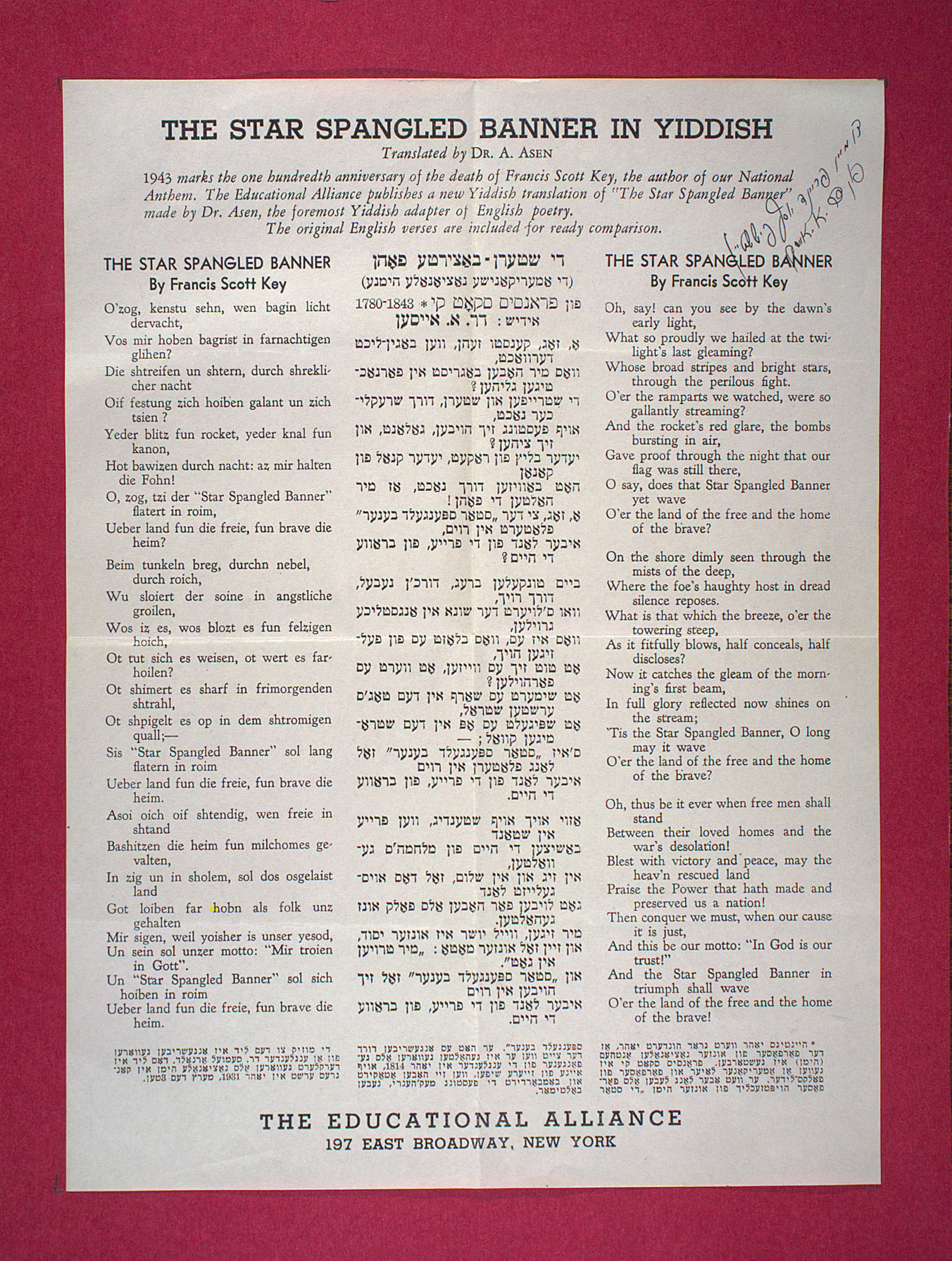
The Star Spangled Banner in Yiddish - Video


It's the 4th of July this week and time for us to sing again the Star Spangled Banner in Yiddish. This version's Yiddish translation by Berl Lapin.

Here is an earlier version courtesy of Jack Balkin1943 translation of the Star Spangled Banner into Yiddish by Dr. Abraham Asen, described as "the foremost Yiddish adapter of English poetry," and proudly presented in commemoration of the anniversary of the death of Francis Scott Key.

O'zog, kenstu sehn, wen bagin licht dervacht,
Vos mir hoben bagrist in farnachtigen glihen?
Die shtreifen un shtern, durch shreklicher nacht,
Oif festung zich hoiben galant un zich tsein?
Yeder blitz fun rocket, yeder knal fun kanon,
Hot bawizen durch nacht: az mir halten die Fohn!
O, zog, tzi der "Star Spangled Banner" flatert in roim,
Ueber land fun die freie, fun brave die heim!


I repost this every few years. Enjoy!

6/18/18

The Oxymoron of Modern Open Inclusive Orthodoxy: My Column for June 2016 for the Jewish Standard

Update: My column was the subject of discussion by Rabbi Steven Riskin and Rabbi Kenneth Brander at a Ohr Torah Stone forum at the Rinat Israel Synagogue on June 13, 2018, moderated by Jerry Silverman, President & CEO, Jewish Federations of North America.

See the video here.

My Column for June 2016 for the Jewish Standard

Dear Rabbi Zahavy,

In the past few years I’ve seen that people use the term “modern Orthodox” in news and opinion articles to describe a current form of Judaism. More recently, I read about a new group that sounds attractive to me, that wants to promote a more “inclusive” Orthodoxy. But I always have understood that Orthodox Judaism clearly says that it is the oldest and the original form of Judaism, that all of its practices are crucial to the survival of Judaism, and that they conform perfectly to God’s will as interpreted by the Orthodox rabbis. Why do people apply these fancy new labels for their faith? And is it hypocritical for me, if I embrace modern values, to continue to stay plain old Orthodox? Or should I join up with the new guys?

Confounded in Clifton

Dear Confounded,

If there was a supermarket where you could buy a religion in a box, you would not find many products with the label description “New and Improved.” But you would find most with the description, “Same Classic Ingredients for Centuries (or Millennia).”

So you are correct to be confused about the term “modern Orthodox.” Orthodox Jewish authorities’ main claim to legitimacy is that the content of their system is not modern. They insist that it is ancient, dating back thousands of years, to God’s covenants with our patriarchs, and to God’s revelation of the Torah on Mt. Sinai. And you legitimately can scratch your head in disbelief when someone comes up with an incongruous title that implies that a religion can be ancient and modern at the same time.

So, you may ask, what then is all this talk about “modern Orthodoxy”? On the surface, I might dismiss that new label, or the similar tags “open Orthodoxy,” and “pluralistic Orthodoxy,” as marketing names without any deep meaning. I might say that they are meant to make the brand of religion that its leaders are selling more attractive to consumers.