I have been a fan of Ben and his bargains for years. Shh. Don't tell anyone. It is a secret between you and me, okay?
Latest Deals...
I have been a fan of Ben and his bargains for years. Shh. Don't tell anyone. It is a secret between you and me, okay? Assyrian mythology is nonsense. But the history of nonsense makes an interesting book.
Lost and Found
By JONATHAN ROSEN
THE BURIED BOOK The Loss and Rediscovery of the Great Epic of Gilgamesh. By David Damrosch. Illustrated. 315 pp. Henry Holt & Company. $26.
The stylized images of ancient Assyrian kings, with their braided beards and Art Deco muscles, riding out in chariots to hunt lions or men, are now familiar, but until the 19th century nothing was known of them. All evidence had been buried for more than two millenniums under the soil of what is today Iraq. How we came to uncover that world, and how that world reached out toward our own, is part of the story David Damrosch tells in “The Buried Book: The Loss and Rediscovery of the Great Epic of Gilgamesh.”
But the kingdom of ancient Assyria held other secrets, even older, and Damrosch is telling that story too. One of the last Assyrian kings, Ashurbanipal, had the literary skills and interests of a scribe. To warfare and lion hunting he added reading, building a great library in his capital city of Nineveh and filling it with thousands of inscribed clay tablets, including several copies of “The Epic of Gilgamesh,” a story already ancient in Ashurbanipal’s time. When Nineveh fell in 612 B.C., the library, loaded with the cultural heritage of ancient Mesopotamia, fell too, its contents lost until the middle of the 19th century, when British archaeologists dug up its remains and British scholars cracked the cuneiform code of the tablets. “Gilgamesh,” the oldest work of great literature we have, sprang back to life, surrounded by the shards of a prebiblical culture that challenged assumptions about the primacy of biblical authority, a concept already crumbling fast in Victorian England.
Damrosch, a professor of English and comparative literature at Columbia, crams more than 4,000 years of history into his narrative without making it feel crammed at all. He accomplishes this in part by telling his story backward, beginning with the 19th century and ending up somewhere around 2700 B.C., when the real Gilgamesh might actually have walked the earth. This is a highly effective strategy, giving the whole book a narrative urgency and a simultaneous sense of archaeological unfolding. Along the way, Damrosch creates vivid portraits of archaeologists, Assyriologists and ancient kings, lending his history an almost novelistic sense of character.
First we meet George Smith, a 19th-century scholar of humble origins who started out as an engraver of bank notes. Fascinated by biblical history, he was drawn to the vast collection of clay tablets in the British Museum, where he proved himself adept at assembling the fragments into a semi-coherent whole, earning himself a spot as assistant curator of the collection. Scholars were only just figuring out how to read cuneiform, the wedge-shaped symbols impressed into clay that look as if tiny birds had wandered over a patch of wet cement. Smith was soon reading it better than anyone else, and in 1872, in a now famous moment of scholarly discovery, he decoded the story of a flood very much like the biblical account of Noah and became so excited he began undressing.
The tablet Smith had translated formed a piece of the “Gilgamesh” narrative, the story of a great king who, after the death of his beloved friend Enkidu, goes searching for immortality. Gilgamesh consults a distant relative, a man who not only survived the terrible flood but was rewarded with eternal life. This relative gives Gilgamesh the bad news: he must die like everyone else.
Damrosch, an eloquent champion of world literature, makes a persuasive case for “Gilgamesh” as a unifying story that knits East and West together. The dramatic narrative of the book’s fortunes accomplishes the same thing: Gilgamesh is a once and future king who fell asleep in ancient Mesopotamia and woke up in the British Museum.
For this reason, the most captivating 19th-century figure in Damrosch’s narrative is Hormuzd Rassam, who seems to embody in his very person the confluence of East and West that fascinates Damrosch.
Rassam, who assisted Austen Henry Layard in his discovery of Ashurbanipal’s library and eventually became a great archaeologist in his own right, was born in Mosul to an old Chaldean Christian family. He converted to the Anglican Church at age 14, was educated at Oxford and, promoted by Layard, became adept at uncovering the buried history of his homeland. His fluency in Arabic and his familiarity with the world of his birth helped him excavate a staggering number of artifacts, which were dutifully sent to the British Museum. Despite experiencing British discrimination, he settled in England. Though Damrosch calls him “both a loyal son of Mosul and a proud participant in the British imperial enterprise,” it is not entirely clear by whose definition he remained “a loyal son of Mosul.”
Damrosch’s eagerness for universal themes leads him to stumble awkwardly in his coda, where he compares Saddam Hussein’s first novel, which draws loose inspiration from “Gilgamesh,” to Philip Roth’s “Great American Novel,” which features a baseball player named Gil Gamesh. Damrosch writes that Hussein and Roth are “both children of Abraham, and both heirs of their common literary father, the globe-trotting Papa Hemingway.” Keen to make this point about “disparate” but “interconnected” authors, he ignores the import of his own chilling disclosure that Hussein most likely murdered the Iraqi writer he forced to work on the book; the notion of Hussein as “author” is a fiction that suits Damrosch’s larger purpose — which, however laudable in its longing for universality, elides differences that matter very much.
Having made his Hemingway-Hussein-Roth union, Damrosch writes that “ ‘The Epic of Gilgamesh’ powerfully illustrates the underlying unity of the extended family that the historian Richard Bulliet calls ‘Islamo-Christian civilization.’ ” The term comes from Bulliet’s book “The Case for Islamo-Christian Civilization,” published in 2004. In that book, Bulliet explains that he has lopped off “Judeo” in his coinage because it evokes only a shared ancient scriptural heritage — not, presumably, a modern political one. Beyond the oddness of enlisting Philip Roth in “Islamo-Christian civilization” is the larger oddness of invoking a book with a polemically exclusionary title. However recently coined and inaccurate the term “Judeo-Christian” may be, replacing it with “Islamo-Christian” — and employing that coinage when arguing for the universal nature of a Middle Eastern epic — is, to say the least, problematic.
Unlike “Gilgamesh,” the Hebrew Bible is at once a part of world literature and the expression of a people still alive in the world, with a modern Middle Eastern present as well as an ancient Mesopotamian past. But ancient Mesopotamian culture has, since its 19th-century discovery, stirred contemporary passions. Damrosch mentions the 19th-century Assyriologist Friedrich Delitzsch only in passing, but his story is instructive. Delitzsch, who became quite famous, came to feel that since “Gilgamesh,” and indeed all of Babylonian culture, were older than the Hebrew Bible — and superior to it — there was no need for the Hebrew Bible at all. An anti-Semite and a German nationalist, he proposed replacing the Old Testament with German folklore.
Though it is easy to dismiss the entirely discredited Delitzsch, the old battles for supremacy and supersession are felt today in subtler, secularized form. Damrosch, who could not be farther from Delitzsch in spirit or intent, blunders into another reductive master narrative. He has done a superb job bringing what was buried to life. Surely it is possible to do this without buying into a narrative that buries that which still lives.
Jonathan Rosen is the editorial director of Nextbook. His most recent novel is “Joy Comes in the Morning.”
 She was pretty and talented and made good films. But she worked for Hitler and the nazis and glorified their vision.
Reich Star
By CLIVE JAMES
LENI The Life and Work of Leni Riefenstahl. By Steven Bach. Illustrated. 386 pp. Alfred A. Knopf. $30. -- LENI RIEFENSTAHL A Life. By Jürgen Trimborn. Translated by Edna McCown. Illustrated. 351 pp. Faber & Faber. $30.
A BRAZEN shout from long trumpets held high at the angle of a Hitler salute. Cut to medium close-up of young Aryan faces with puffed cheeks. Dolly back as two new biographies of Leni Riefenstahl appear virtually at once. Jürgen Trimborn’s book, well translated from the German by Edna McCown, has the better pictures. Steven Bach’s book, backed up by his deep personal experience as a high-echelon film executive handling dingbat directors, has the better text. Though neither book is precisely adulatory, put them together and they add up to an awful lot of attention. She might be dead, but she won’t lie down.
The same was true for much of the time she was still alive. Born in 1902, she lived for more than a hundred years. In less than half that time, she acquired a brilliant reputation. But she had to spend the rest of her life mounting a posthumous defense of it.
Already nationally famous in the pre-Nazi period as an actress and director, in the Nazi period she grew world famous by giving the new, globally ambitious political movement a screen image of overwhelming authority, glamorous even to those who sensed its evil.
Some spectators thought even at the time that her cinematic gift had served to legitimize a murderous ideology, but almost nobody belittled her artistic talent. She was thus able, when the Nazis lost, to invoke the principle that art trumps politics. Photographed too often with her raised hand pointed in Hitler’s direction, quoted too often on the subject of his transformative vision, she was unable to deny that she had held her mentor in high regard, but she never stopped denying until her long-postponed last gasp that she had ever known much about what the Nazis were really up to. She had been too busy being a great artist.
To make this line stick, she had the help of her two big movies from the 1930s, “Triumph of the Will” and “Olympia.” Though the first now stands revealed
as a gruesomely choreographed hymn to naked power and the second spends too much of its time weighing sport down with a neoclassic gravitas that feels like being hit over the head with the Parthenon, there were, even after the end of the Thousand Year Reich’s 12-year run, plenty of knowledgeable critics in the victorious democracies who called her portentous epics masterpieces. For her cinéaste admirers, the aesthetics left the ethics nowhere. It seemed a fair guess that anyone so wrapped up in creating an imaginary world would be bound to miss the odd detail about what was going on in the real one. The Holocaust? Forget about it.
To assist in the forgetting, Leni also had the help of her histrionic abilities, which might never have been subtle but were always in a good state of training, because there had rarely been a moment of her conscious life when she had not shown her emotions as the only way of having them. (In her early phase as a film star, she hammed it up even in the stills.) She would act indignant when she was asked an awkward question. If you asked it again, she would storm out, fall down, shriek, weep.
Above all, however, she had the help of time. After the trap-door stopped rattling and banging at Nuremberg, it got harder and harder to find a Nazi with a famous name. The ones in Argentina had unlisted telephone numbers. But Leni Riefenstahl’s new shyness was all a pose. She had a way of hiding only where she could be found, and she never ceased to assure the world that although she and Hitler had spent a lot of time talking in private, she never knew anything about what was happening to the Jews.
More than half a century went by and she was still there, popping up at film festivals to keep her cinematic legend in trim, conspicuously disappearing into Africa to build a new career as a photographer, steadily acquiring the validation that comes automatically with endurance. “What am I guilty of?” The martyred look that went with that refrain made it seem as if the suffering had all happened to her. (The dogged Trimborn, a professor at the University of Cologne, is especially good at tracking her through a final phase that lasted longer than the Pleistocene.) She showed no remorse, saying that she had no reason to. Those who were all too well aware that she did have reason to died off faster than she did, so finally there were whole new generations to take her genius for granted.
We might as well do the same, because over the question of her talent it isn’t worth fighting a battle. Among the people who run the movie business anywhere in the world, women are a minority even today, and still under pressure to exercise feminine wiles. When the lowly born Leni was starting out, the minority, even in go-ahead Weimar Germany, was the merest handful. Luckily for her, she had feminine wiles to burn: until she was old and gray, she met few men who didn’t fall for her on the spot. It could be said that she had looks and energy but no real brain. The evidence was overwhelming that she didn’t need one.
As a young actress, she was so beautiful that other women could find nothing bad to say about her except that her eyes were too close together. But her acting on screen was strictly frown, laugh, bubble and jump. She made it as a star because she was good at climbing rocks. There was a whole genre of German movies about clambering around daringly at high altitude. In a string of mountain pictures including “The White Hell of Pitz Palu,” Leni proved that she could do that stuff without a double. There was no peak, however vertiginous, that she could not sprint to the top of wearing very few clothes. On the other hand, there was no director, however illustrious, whom she could not hurl herself beneath wearing no clothes at all. Or at least she gave him the illusion that she might: a power of suggestion that we can usefully regard as her most persuasive thespian gift.
FIXED on becoming a director herself, she applied the same gift when bending producers and studio bigwigs to her triumphant will. Her real originality was in setting her sights high, up there where the men were making the decisions. All the right potentates duly succumbed to her allure. “I must meet that man” was an exhortation often on her lips. Before the Nazis came to power, some of the men she felt compelled to meet were Jews. Afterward, none of them were. It could be said that she never came out as an anti-Semite, but it could also be said that there is a green cheese moon.
Made on the eve of the Weimar Republic’s final agony, her film “The Blue Light” — she was producer, director, writer, editor and star — drew less than universal acclaim. She blamed the Jewish critics. After the Nazis came to power, her co-writer and co-director on the movie, Bela Balazs, was too insistent about getting paid. Balazs was a Jew. She had his name removed from the credits to render the film judenfrei, and eventually found a sure-fire way to keep him out of the picture permanently. She turned his name over to Julius
Streicher. To defuse the significance of an act like that, it wouldn’t be enough to call her ignorant. You would have to call her an idiot. Everybody knew what Streicher stood for. Gauleiter of Franconia, editor of the lethally scurrilous Nazi weekly Der Stürmer, he was the most famous Jew-baiter in Germany.
But she had a bigger buddy than Streicher. Hitler had liked “The Blue Light,” so when she once again said “I must meet that man” her wish was easily answered. Coy for the rest of her endless life on the subject of whether she threw him one, she always wanted it to be thought that only his total dedication to the cause held him back. Given her track record with men, the mere fact that she spent time alone with him was enough to confer on her all the power of the Führer’s public darling. (Hardly anybody knew about Eva Braun. Everybody knew about Leni.) She was given full access to film the 1934 party rally at Nuremberg. After six months of editing — possessing almost no sense of story, she invariably had to dig her movies out of a mountain of footage — the finished product appeared in 1935 as “Triumph of the Will.”
Hitler loved the movie. Critics who still feel the same way are apt to underrate the part played by Albert Speer, who came up with the lighting and décor all on his own. The camera had to look up at Hitler because Speer put him there. But Leni undoubtedly did a thorough job of making what was already frighteningly impressive look more frighteningly impressive still. If 10,000 men marching in lock-step turn you on, Leni could make them look like 20,000.
The top Nazis were delighted. They included Joseph Goebbels, whom Leni, after the war, found it expedient to characterize as a dangerous enemy jealous of his bailiwick as the supreme studio executive nominally in charge of Nazi movies. In fact Goebbels, generously overlooking her rejection of his advances — and for the idea that he ever made a pounce, we have only her notoriously unreliable word — thought highly of her artistic prowess, blowing his top only when she showed signs, in his view, of spending the Reich’s money as if it were her own. (Bach, who wrote “Final Cut,” the best-ever book about a film director — Michael Cimino of “Heaven’s Gate” — on the rampage, is especially good on the subject of how Leni treated a budget as the merest letter of intent.)
After “Triumph of the Will,” the road was open for Leni to do what she wanted. What she wanted was to turn the 1936 Berlin Olympics into a celluloid masterpiece. By far her most palatable cinematic achievement, “Olympia” was, and remains, crucial to her later reputation. Even more crucial is that the film is not notably a Nazi one. Hitler the arch-nationalist didn’t enjoy being stuck with staging an international event, but while he was at it he had enough sense to go light on the ideology. Few restrictions were placed on what Leni could film. Not many Jewish athletes were there to be filmed anyway, but there were black athletes present, and one of them was Jesse Owens, whom Leni didn’t hesitate to caress with her lenses as if he were a godlike figure.
SHE wasn’t having a thing with Owens. She was having that with another American, the decathlete Glenn Morris, whom she obliged to add an 11th discipline to his event. But she filmed Owens with loving appreciation. It’s a shameful consideration that no Hollywood director would have been encouraged to do the same, at the time. Owens in repose looked lovely anyway, and on the move he was poetic, but it took a fine eye and a lot of knowledge to get the poetry on film, and Leni knew how to do that with him and with many another athlete. It was only logical for the camera to climb the tower with the diver, for example, but she figured out how to do it.
Susan Sontag later made a serious mistake in arguing that “Olympia” was entirely steeped in fascist worship of the beautiful body. But it’s nature that worships the beautiful body. Fascism is natural. That’s what’s wrong with it: it’s nothing else. Despite the too often prevailing calisthenic mass maneuvers, as if Busby Berkeley had met Praxiteles, much of the reputation “Olympia” has for beauty can thus safely be endorsed, but always with the proviso that a lot of the athletic events were beautiful anyway, and that her technical inventions for capturing them would eventually suffer the fate of all technical inventions and be superseded: everything she did in Berlin in 1936 was topped by what Kon Ichikawa did in Tokyo in 1964. Nevertheless, Leni, with her raw material handed to her on a plate, and unhampered by those requirements of invented narrative that she could never manage, had made quite a movie for its time.
IN November 1938, Leni, who had probably always had one eye on Hollywood, flew the Nazi flag to America. She had every reason to expect that she was heading for a big welcome, and she initially had the beginnings of one, but five days after her ship docked in New York, Kristallnacht happened in Germany. If ever there was a time to play the artist, that was it. But she blew the scene with what she said. She said that nothing had happened, and that to suggest such a thing was a slander.
Walt Disney gave her a tour of his studios, but the rest of Hollywood gave her the freeze. Almost nobody else in America except Henry Ford even invited her for drinks. Back in Germany, she reported to Goebbels, who was suitably indignant on behalf of his thwarted artist. “The Jews,” he wrote in his diary, “rule by terror and bribery.” When the Nazi counterterror against the Jews went rolling into the East, Leni, in sole command of her own film unit, was along for the ride, but she saw something in Poland that stopped her in her tracks, even if it didn’t stop the Nazis. She was accidentally present at a mass shooting in the town square of Konskie. According to her later testimony — or rather, according to the lack of it — she was the only eyewitness to the occasion who managed not to notice that all the victims were Jews. Nevertheless, she was photographed looking distraught.
As a general rule, any expression on Leni’s face when a camera was pointing in her direction was adopted at her own command, but in this case it might have been possible that her distress was genuine. Whatever the truth of this permanently controversial moment, however, it seems probable that Leni, when she next saw Hitler, asked permission to be excused from the war. She didn’t opt out of the Nazi Party’s inexorable conquest of the world — she was there to film Hitler’s victory parade in Warsaw, the only time he lent his presence to such an event — but she never again went near a battle. Instead, she resumed filming “Tiefland,” the dramatic blockbuster that she had abandoned after the Nazis came to power. Here was the chance for her to prove, to the full satisfaction of her postwar admirers, that she was indeed an artist who had no knowledge of what the Nazis were really doing.
Once again she blew it. Financed on a no-budget basis at Hitler’s personal orders, “Tiefland” had unlimited resources, including an infinitely flexible schedule. Bach, no doubt still haunted by memories of Michael Cimino’s plausible extravagance, is well set to evoke the consequences, one of which wasn’t funny at all. Her pet project needed some Spanish-looking extras, so Leni shipped in some Gypsies from a holding camp where they were waiting for a train to Auschwitz. In 1982, long after the war, the tirelessly litigious Leni sued a documentary maker who suggested that she had known about Auschwitz. She probably didn’t know. But she certainly did know that she was employing forced labor; and her claim that she met almost all of the extras after the war was a flat lie.
She lied about everything. She just went on lying until people got tired, or old, or died. One of her most telling lies was the one she told about Streicher. She said that she had loathed him. But there is preserved correspondence to prove that she invited his company and treated him as a close friend until quite late in the war. The idea that Streicher would never mention to her what was happening to the Jews is preposterous. He was proud of it, and was eventually hanged for it.
Leni, although she never managed regret, had enough sense to feign ignorance. But one of her closer questioners got the admission out of her that really mattered. He was Budd Schulberg. His famous days as a screenwriter were still ahead of him, but he would never dream up a neater scene than the one he played out with Leni when he interviewed her in 1945, shortly after her arrest by American soldiers. After unrolling her usual impatient rigmarole about having known nothing about any Nazi atrocities, Leni made the mistake of saying that she sometimes, against her will, had to do what Goebbels wanted, because she was afraid of being sent to a concentration camp. Schulberg asked why she should have been afraid of that, if she didn’t know that concentration camps existed.
So there was the whole story. For anyone with a memory for recent events, the question of Leni’s moral status was settled. What came next, stretching on to the end of the millennium and now beyond, was the question of her artistic stature, supposedly a different thing. She built another career photographing tribesmen in Africa, and then another one, filming life below the waves in yet another new role as the oldest diver in the world. And as the people with a memory for the real world grew fewer, those who knew about nothing except the movies gradually redefined the issue.
At the end of the first “Star Wars” movie, George Lucas copied the ambience of “Triumph of the Will” with no apparent sense of how he was really proving that the cause in which Luke Skywalker and his friends had just triumphed could not have been worth fighting for. Lucas wasn’t alone: Trimborn does a useful job of rounding up the unusual suspects. Mick Jagger, Andy Warhol and Madonna all enrolled themselves on the growing list of Leni’s fans. So did Siegfried and Roy. Francis Ford Coppola said he admired her. Steven Spielberg said he wanted to meet her. If he had made “Schindler’s List” 10 times, he could not have undone the portent of such a wish, because he was really saying that there can be art without a human framework, and that a movie can be made out of nothing but impressive images. Some of Leni’s images were indeed impressive. But the question is never about whether or not you are impressed. The question is about whether you can keep your head when you are. Leni Riefenstahl was impressed by the Nazis, and look what happened.
Clive James’s latest book, “Cultural Amnesia: Necessary Memories From History and the Arts,” has just been published.
Apple Cult Becoming a Religion
By DAN MITCHELL
APPLE will not release the iPhone until June, but Leander Kahney, the writer of “The Cult of Mac” blog, posited this week on Wired News that the new phone is already partly responsible for a major change in how the company is perceived (www.wired.com). After nearly three decades, Apple is finally being taken seriously not just by the true believers, but by just about everybody.
According to Mr. Kahney, this shift has taken place in the last few weeks, as both the iPhone and, more recently, Apple TV, have quickly become “must have” products. “A lot of people thought Apple got lucky with the iPod,” Mr. Kahney wrote. “It was a one-hit wonder, a fluke not likely to be repeated.” But the iPhone is already thought of as an “industry-changing smash hit,” and Apple TV, which at first drew shrugs, now may even eclipse the iPhone, according to the predictions of some (though by no means many) people (ipodnn.com).
Apple TV, which began shipping this week, stores up to 50 hours of video, which can be wirelessly beamed from a computer to a television set. Like several other competing products from the likes of Sony, Microsoft and TiVo, it aims to capitalize on the increasing availability of downloadable movies and TV shows.
Apple’s decision to move to Intel processors is another big reason for what Mr. Kahney says is “a cultural shift that’s changing the way people think about the company.” The Mac’s ability to run both Apple’s operating system and Microsoft’s Windows (by using BootCamp software, which is still in beta), means some organizations are able to save money by using more-expensive Macs. Wilkes University in Pennsylvania, for example, recently dumped all its Windows-only machines in favor of Macs because the university now can do just as much with fewer computers (computerworld.com).
The “dual boot” functionality also means that it is far easier to find needed software. “The old argument against Macs is moot,” Mr. Kahney writes. “New Intel Macs can run Windows software as well as any PC.” And technology managers like the Mac’s relative protection against computer viruses and security breaches.
Perhaps most intriguingly, Mr. Kahney points to Apple’s steadfastness in keeping its products proprietary as a main reason for its success. Apple for decades has weathered criticism that the reason it was marginalized by the likes of Microsoft was its refusal to allow third parties to develop related products. But “Apple’s traditional closed system,” Mr. Kahney writes, “is now a selling point.”
The popularity of the iPod and iTunes, he writes, shows that consumers seem to prefer buying “products and services from one company that are guaranteed to work well together.”
Cathy wrote "the weekly 'From the Left Coast' column for National Review Online, a monthly column for Independent Women's Forum and freelances other places, such as the Los Angeles Times and Wall Street Journal op-ed pages. She previously wrote columns for: Buzz, Mediaweek, UPI, New York Press and Salon. Her work has also appeared in Reason, Penthouse, TV Guide, the National Post and Forbes."Cathy Seipp Part Two Hall Of Fame For Female Journos Cathy Seipp Roast
She was 49.
Seipp wrote the weekly "Cathy's World" column for UPI. She was a columnist for Pages, the books magazine, and has also written for Mediaweek, American Journalism Review, Penthouse, Forbes, the Weekly Standard, TV Guide and Reason.
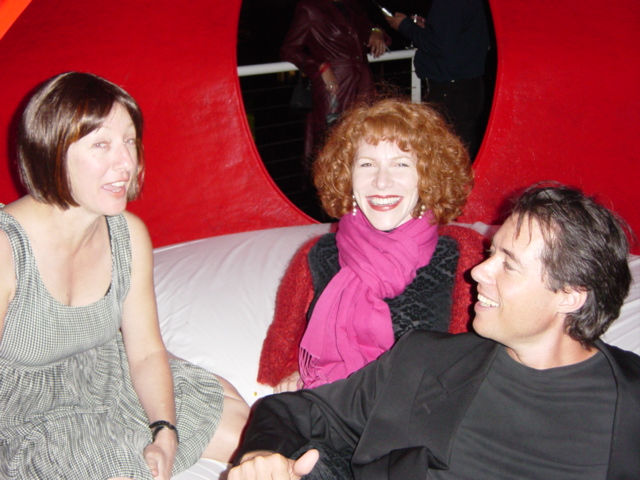
Shortly after this picture was taken at The Standard in downtown Los Angeles on Oct. 8, 2002, I asked Cathy if she had changed her hair style.
"It's a wig," she said.
"Why?"
"I'll tell you in a minute," she said. "After the pictures."
I leaned back into the trampoline while Cathy sat up straight and told me she had lung cancer. That she'd had surgery but the cancer was too far gone and they'd just stitched her back together and prescribed chemotherapy, which caused all her hair to fall out.
"Don't blog this," she instructed. And I didn't....
Here's part of FM's post:
Personally, I think this is a case of too little, too late. The MO-NRP world wasted its time on land and expanding Jewish 'control' over the West Bank and Gaza. While it did so, haredim hijacked the apparatus of state religion, making life worse for everyone but, perhaps, a few haredim themselves. And, at the same time, secular Israelis and the Israeli center ? made up mostly of traditional Jews who at one time valued rabbis and Orthodoxy, if not as a daily way of life then as an ideal ? have moved farther away from religion and have increasingly hostile views of Orthodoxy and of rabbis.
Both Netanyahu and Olmert need the haredim to have a chance of forming a government in the next election. Therefore, neither will risk alienating haredi leadership. This means a new MO-NRP religious court system is dead in the water. It also means MO-NRP leadership has again failed, and that is no surprise ? they have consistently failed most every test for last 40 years.
 Why would a scholar write an article for the Jewish Press? And why would a professor exaggerate the importance of a rabbi? Comparing Breuer's methods to Brisk methods needs to be argued and defended and explained. You just cannot drop these pearls out of the sky and then move on. So if Carmy believes the impact of Breuer was so dramatic, then let's see a few for-instances from Carmy's own published books and articles. Or from the work of others.
The Reb Chaim Brisker Of Bible ScholarsBy: Rabbi Shalom Carmy
There are great teachers whose impact is limited to their students. Greater still are those whose students initiate students of their own. The greatest teachers, however, influence not only the direct line descending from them, but an entire climate of thinking. All of us are their talmidim.
Wednesday, March 21, 2007Twentieth-century Orthodox Bible study boasts two such figures. Nechama Leibowitz’s writing, teaching and broadcasting turned the exacting, microscopic study of Jewish parshanut into an exciting and popular pursuit. And Rabbi Mordechai Breuer fashioned the tools that enabled Orthodox students to confront the literary problems raised by modern biblical criticism. He entered a situation where the Orthodox approach was an apologetic one, in which the Torah was to be defended against heretical assault...
A political mystery was solved yesterday with the unmasking of the maker of a much-discussed Internet advertisement that portrayed Senator Hillary Rodham Clinton as Big Brother. The creator, it turned out, worked for consultants to Senator Barack Obama, a rival for the Democratic presidential nomination.
A spokesman for the Obama campaign said last night that the maker of the advertisement — known as a “mashup” video in Internet parlance — had not worked on the Obama campaign account.
After The Huffington Post blog identified him as Philip de Vellis, Mr. de Vellis wrote in his own item on the same blog that the Obama campaign had not been aware of the advertisement and that he had resigned from the consulting firm, Blue State Digital. The campaign was continuing to use Blue State as an Internet vendor.
The advertisement, which has received more than 1,731,000 views on YouTube during the last two weeks, shows dronelike people marching and sitting at attention as Mrs. Clinton speaks on a giant screen about her wish to have a “conversation” with Americans about the future of the country...
The interesting parts of this account from the Conservative Voice are (1) the standing ovation for Hagee and (2) the revival of the Hatikvah. We've reviewed and interviewed David Brog, author of Standing With Israel: Why Christians Support The Jewish State, who now works for the good reverend, and we have a positive view of Hagee's sincerity towards Israel and the Jewish people.
Repacking AIPAC
The date was almost two years ago, May, 2005, and the Washington, D.C. AIPAC Policy Conference had attracted some 5,000 participants from across the United States. Included among the attendees were about a thousand college students. AIPAC invited a large number of top ranking university student body presidents, many of whom were not Jewish and knew little or almost nothing about the State of Israel. Along with the above participants was a sizable delegation of European Jewish community leaders; many stunned by their own personal experiences of the European rise of Islam and the erupting anti-Semitism under the guise of anti-Zionism. It appeared that the European delegates came to America's AIPAC Conference looking to gain a revitalizing and energizing injection of Jewish and pro-Israel strength. Little did they know that weeks after their return, the London subway terrorist bombing would shock Europe and become a shaping force in future foreign policy.
Days following the London bombing, British leadership, instead of harshly criticizing terrorists and terrorism, declared that the resolution of the Israeli-Arab issue was to be even more directly addressed. Just a few weeks later the virtual overnight Israeli evacuation of the Gaza Strip occurred. The fact that a potential Palestinian state was in days going to be delivered on a silver platter to the Arabs, made no difference to the organizers and executers of the London terrorist bombing. The terrorists sent the world another message that the Gaza Disengagement would not change a thing and would not resolve "shamed" or damaged Islamic Arab honor.
But in the banquet halls and large meeting rooms of the 2005 AIPAC Conference, the mood was quite different. The Conference theme centered around the Gaza Disengagement count down and pre-event fanfare, building infectious and blinding excitement leading to Israel's "bold and courageous" move to "unilaterally initiate the peace process". This landmark disengagement was to be a sign to the Arabs and the World that the commonly reprimanded and frequently UN condemned Israel was ready and willing to make "bold and broad" concessions for peace. Along with the Gaza disengagement theme, AIPAC's second theme was to enthusiastically praise and kindly welcome the official replacement for the despised and intransigent Yassir Arafat. The new breath of fresh air was no other than Mr. Mahmoud Abbas. Somehow forgetting that Abbas was Yassir Arafat's right hand man for the past forty years, and forgetting that Abbas's academic studies focused on Holocaust denial, Mr. Abbas was now being touted as a wonderful modern leader, peace maker, and a responsible state builder for the Palestinian people. It was stressed that Mr. Abbas would rapidly accomplish that which his predecessor Arafat never did; he would be the messiah-like king who would lead his people into an era of peace, a homeland, and a non-hate filled recognition of Israel.
The 2005 AIPAC keynote speakers included Prime Minister Ariel Sharon, Hillary Clinton, Condoleezza Rice and various Middle East experts as well as congressional leaders. They all mistakenly echoed the expectation and prediction that a new era of peace and reconciliation was about to dawn. The AIPAC thrust was so thoroughly convinced and intent on the Gaza Disengagement being a total success and Abbas being the Palestinian dream leader that no backup plan or "what if it doesn't work out" discussion was even scheduled or entertained at the conference.
At the same time of the 2005 conference two senior AIPAC staff members were being questioned for allegedly passing American information to Israel. This was another Pollard-like situation which now put the focus on AIPAC's positioning and respect in the Washington, D.C. beltway.
There is a normal standard operating procedure at American Jewish events which is to sing the American national anthem followed by the Israeli national anthem. However, due to the potential concern questioning AIPAC's values as being America first or Israel first, the decision was made to omit Israel's anthem, the Hatikvah, "The Hope". AIPAC?s deletion of the Hatikvah was a dramatic statement and reflected its fear that American public opinion could possibly shift if the Israel-American dual loyalty question should arise.
Now two years later, AIPAC's Washington Conference was the largest ever. Some 6,500 people filled the Washington Convention Center with pride and conviction, eager to hear the voices, views and projections of America's and Israel's top leadership. California alone brought some 1,200 representatives, four people came from Hawaii, and overall the conference was filled with rabbis, synagogue congregants, organizational leaders, and a strong crowd of mature and sophisticated high school and college students.
This year, the 2007 theme of AIPAC was to focus on preventing Iran from reaching nuclear success as well as to insure that Hamas would not receive American and international funding prior to recognizing Israel's right to exist. The AIPAC speakers had moved away from speaking in the dream-filled terms of 2005. Now, the Gaza Disengagement was recognized for not fulfilling even one of the promises imagined by the Sharon government. The "bold and courageous" steps for peace led to thousands of missiles being shot into pre-1967 Israel, kidnapped Israeli soldiers, a destroyed Gaza farming industry, and hundreds of execution styled murders between Hamas and Fatah as well as between feuding Arab family factions. Gaza was now under endless lawlessness, endless weapon smuggling, uncontrollable contraband and explosive tunneling, and Gaza had become the safe and fear-free headquarters for the leading terror organizations as well as a new Al Quaeda office. The Hamas landslide election victory, children's camps for terrorist training, the ludicrous missile-firing cease fire agreement, and the recent Mecca Summit which emphasized that Hamas is in control and no recognition of Israel would be discussed are additional results of the Gaza disengagement. The PA Unity Government, siding with Hamas, further challenged those who tried to preach that Abbas and his Fatah party ever desired to recognize and work with Israel.
Only Knesset Member Ephraim Sneh stated that even if Hamas won't recognize Israel's existence, Israel must still make every effort to negotiate and therefore trust the Hamas government. The AIPAC audience gave very few applauds to Mr. Sneh's political position.
The most memorable event of the 2007 AIPAC conference was a dynamic twenty minute speech delivered by Pastor John Hagee. His speech received no fewer than 14 major ovations and many of them were standing ovations. This was a first for AIPAC to invite a Christian pastor to be the keynote speaker for their opening session. Pastor Hagee's impassioned speech will most likely go down in history as being the most memorable, emotional, and eye-opening event at an AIPAC conference. With his clear and succinct evangelical preacher vocal style, Pastor Hagee introduced to the national and international Jewish leadership attendees that the Jews are not alone in their support for Israel, and that at least 50 million Christians are fervently standing with them. He boldly called for a stop to appeasement and he fearlessly called for a united and undivided Jerusalem. Both statements received ovations that climaxed in a lengthy final standing ovation leaving few of the 6,500 participants choosing to remain in their seats.
Most Jews have never heard a Christian pastor speak with such conviction for the Jewish people without a hidden agenda for conversion. Most Jews have never heard a Christian speak with such passion for the cause to build and maintain a healthy Jewish state. Upon witnessing this Christian-Zionist speech, many AIPAC participants were left in shock as well as filled with pride, happiness, and amazement.
The strongly upheld 2005 AIPAC euphoria believed wholeheartedly in the "disengagement" solution and that Mahmoud Abbas would become a messianic-like leader. Within several months, the euphoria crashed as the Gaza Strip turned into something much worse than the lawless "wild wild West". Even though Abbas turned out to be basically powerless, highly disrespected among Palestinians, and a two-faced political disaster, sadly today, significant political leaders as well as Jewish leaders continue to redesign Abbas, justify his duplicitous behavior, believe in him, and even call him a ?moderate?.
Now, Christians are being taught to recognize that terrorism is evil and that the terrorists not only desire to destroy Israel and the Jewish People, but America as well as all non-Islamic believers. In light of the Holocaust and the failed Christian performance to actively care and protect the Jewish People, Christians are now aware that the terrorist organizations and Iran's nuclear developments will not stop with Israel's destruction. They know that the Iranian nuclear crosshairs are also focused on America.
The 2007 AIPAC Conference demonstrated that there is a significant number of Christians throughout the world who will stand by Israel, protect Israel, and bless Israel for all its good and glory. In that light, there was a return of "hope" to AIPAC. The Hatikvah, "The Hope", Israel's national anthem, was back on the AIPAC program.
Following the singing of America's national anthem, the pride-filled 6,000 plus AIPAC voices dramatically sang Hatikvah. In spite of the long list of worldwide bleakness, tragedies, horrors, and failures, for 2007, there was a repackaged and repacked AIPAC. There was a new "tikvah", hope, and a renewed strength to face the coming reality without the blinders of the past, but with clear convictions which can once again be widely felt, strongly articulated, and powerfully heard.Daryl Temkin is the founder and director of the Israel Institute. He writes the weekly contemporary issues column titled, "Pivotal Thought".